Moonwalking with Einstein by Joshua Foer: Summary and Review
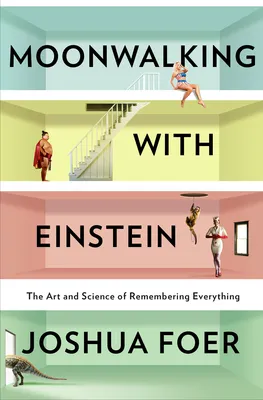
Moonwalking with Einstein is a book by Joshua Foer that looks at the modern revival of the ancient craft of memory. The book describes the journey of the author as he goes from a journalist who is writing an article about memory competitions, to a mental athlete, obsessed with the sport, who eventually wins the 2006 USA Memory Championship.
A Summary of Moonwalking with Einstein
Moonwalking with Einstein is an ideal book for people who want to learn about the memory sports scene. It doesn’t cover how to use the techniques, but our website can help you with that part. If you’re interested in the modern version of memory competitions, be sure to also try our free online memory competition platform.
The early part of the book covers stories that most mnemonists will be familiar with like:
- Simonides of Ceos — the Roman myth about the origins of the method of loci
- Solomon Shereshevsky — the mnemonist known as “S” who was studied by Alexander Luria in the early part of the 20th century
- How the brain structure of London taxi drivers is physically different from most other people
The book explores many fascinating aspects of human memory as Foer meets with well-known savants and brain researchers as he trains for the 2006 USA Memory Championship.
Foer’s memory training is assisted by Grand Master of Memory, Ed Cooke, who appears throughout the book:
“I have to warn you,” Ed said, as he delicately seated himself crosslegged, “you are shortly going to go from having an awed respect for people with a good memory to saying,’ Oh, it’s all a stupid trick.’” He paused and cocked his head, as if to see if that would in fact be my response. “And you will be wrong. It’s an unfortunate phase you’re just going to have to pass through.”
Near the beginning of the book, Foer writes:
Ed had explained to me that the competitors saw themselves as “participants in an amateur research program” whose aim was to rescue a long-lost tradition of memory training that had disappeared centuries ago.
About the Memory Techniques
Moonwalking with Einstein isn’t a “how-to” manual, but there were many interesting techniques mentioned in passing. I’ve listed a few important quotes below.
If you’re interested in more information about the methods, also check out our page on how to learn memory techniques from Moonwalking with Einstein.
First, here’s a video of Joshua Foer demonstrating how to memorize pi:
The book talks about using body parts as memory palace locations on a large scale:
Dr. Yip Swee Chooi, the effervescent Malaysian memory champ, used his own body parts as loci to help him memorize the entire 56,000-word, 1,774-page Oxford Chinese-English dictionary.
Edit: as Yan mentioned in the comments below, the above quote seems to be incorrect. Dr. Yip Swee Chooi apparently doesn’t use his body for storing the dictionary, but uses memory journeys through shops and other locations.
It mentions how Gunther Karsten creates mnemonic images for words:
[In the poem competition, Gunther Karsten] assigns every single word to a route point… he has created his own dictionary of images for each of the two hundred most common words that can’t easily be visualized. “And” is a circle (“and” rhymes with rund, which means round in German). “The” is someone walking on his knees (die, a German word for “the,” rhymes with Knie, the German word for “knee”). When the poem reaches a period, he hammers a nail into that locus.
How actors chunk and memorize lines:
Many actors will tell you that they break their lines into units they call “beats,” each of which involves some specific intention or goal on the character’s part, which they train themselves to empathize with. This technique, known as Method acting, was pioneered in Russia by Konstantin Stanislavski around the turn of the last century.
(Edit: scroll down to read Ben Pridmore’s comment about this, below)
…[he] has been developing a new mnemonic system for the [names and faces] event that would assign numerical codes to eye color, skin color, hair color, hair length, and mouth shape.
On training:
[Anders Ericsson] told me to find a metronome and to try to memorize a card every time it clicked. Once I figured out my limits, he instructed me to set the metronome 10 to 20% faster than that and keep trying at the quicker pace until I stopped making mistakes. Whenever I came across a card that was particularly troublesome, I was supposed to make a note of it and see if I could figure out why it was giving me problems. It worked, and within a couple of days I was off the OK plateau and my card times began falling again at a steady clip.
On placing mnemonic images:
“Don’t try to see the whole image,” [Ed Cooke] said. “You don’t need to. Just focus on one salient element of whatever it is you’re trying to visualize. If it’s your girlfriend, make sure that before all else, you see her smile practice studying the whiteness of her teeth, the way her lips freeze the other details will make her more memorable, but the smile will be key. Sometimes a stab of blue that smells of oysters might be all the recall you get from some particular image, but if you know your system well, you should be able to translate that back again. Often, when you’re really coming for it, the only traces left by a speedily pack of cards will be a series of emotions with no visual content whatsoever.
Ed Cooke’s caution about changing mnemonic images:
…since every change to your mnemonic system leaves behind a trace that can come back to haunt you in competition. And if there’s one thing a mental athlete wants desperately to avoid, it’s for a single card or number to trigger multiple images on game day.
Cooke’s advice on getting to know your mnemonic images:
“Well, you’ve got to get to know your images better… Starting tonight, take a suit at a time and really spend meditative time with each character. Ask yourself what they look, feel, smell, taste, and sound like; how they walk; the cut of their clothes; their social attitude; their sexual preferences; their propensity to gratuitous violence…”
Cooke’s advice on the psychological effect of certain mnemonic images:
“I eventually had to excise my mother from my deck. I recommend you do the same.”
And more:
- How Foer trained for the “Tea Party” event: page 238
- Why to stop practicing one week before the competition: pages 238-239
- Ed Cooke on lighting the journey correctly: page 243
- Word memorization tactics: page 252
- Card recall tactics: page 256
On the Modern Education System
One of the most important chapters in the book is about the history of memory techniques in education. Foer writes about why there was a backlash against memorization in education, and how things may have swung too far in the wrong direction.
Memorization has been completely ripped out of some educational methods with detrimental results. Modern experiential education is great, but it should be balanced with intense training in the memorization of information.
I remember a history teacher once telling me that it wasn’t important to memorize dates, but just to know the overall concept of events throughout history. With what I know about memory now, the first thing that I would do is memorize all the dates.
As the book mentions, the purpose of memory techniques isn’t rote memorization for its own sake; it is to “create a conceptual framework in which to embed” what is learned:
…you can’t have understanding without facts. And crucially, the more you know, the easier it is to know more. Memory is like a spider web that catches new information. The more it catches, the bigger it grows. And the bigger it grows, more it catches… There is a feedback loop between [memory and intelligence].
The Link between Memory and Creativity
Foer writes about the link between memory and creativity, quoting Tony Buzan:
“The Art and science of memory is about developing the capacity to quickly create images that link disparate ideas. Creativity is the ability to form similar connections between disparate images and to create something new and hurl it into the future so it becomes a poem, or a building, or a dance, or a novel.”
I think that memory techniques are a very powerful way to increase creativity. Improved creativity is one of the first benefits I noticed when I first started memory training.
Our Book Review
If you have any interest in the subject of memory, this book is essential reading. Finally, there is a book that I can recommend to people when they gave me strange looks about my hobby of trying to memorize long strings of what appear to be cold, meaningless numbers.
The arrival of this book has been a major step in paving the way for the revival of the ancient, lost craft of memory. The book is easy to read and provides a more gentle introduction to the topic than most memory enthusiasts are able to provide.
The book doesn’t provide detailed instructions on how to memorize things, so if you are interested in learning memory techniques after finishing the book, join our free community and download our free ebook, Learn the Art of Memory.
For another review of Moonwalking with Einstein, check out pwgearguy’s review.
Bill Gates also highly recommended Moonwalking with Einstein. Check out this great review:
Of the five books I finished over vacation, the one that impressed me the most – and that is probably of broadest interest – is Moonwalking with Einstein: The Art and Science of Remembering Everything, by science writer Joshua Foer. This is an absolutely phenomenal book that looks at memory and techniques for dramatically improving memory. Foer actually mastered these techniques, which led him to the finals of the U.S. Memory Championship. His book gives fascinating insights into how the mind works. (I have more to say in my separate review of Moonwalking with Einstein.)
If you want to learn the techniques from the book, see our how to learn memory techniques page.


