How to Memorize Vocabulary Words Fast
In this post, we’ll learn the basics of how to memorize vocabulary words faster and more easily using memory techniques.
Remember Vocabulary with the Linking Method
One of the common ways to memorize vocabulary is to link the word that you want to remember with a visual image.
The basic technique is the same whether you are learning a word in your native language or a foreign one.
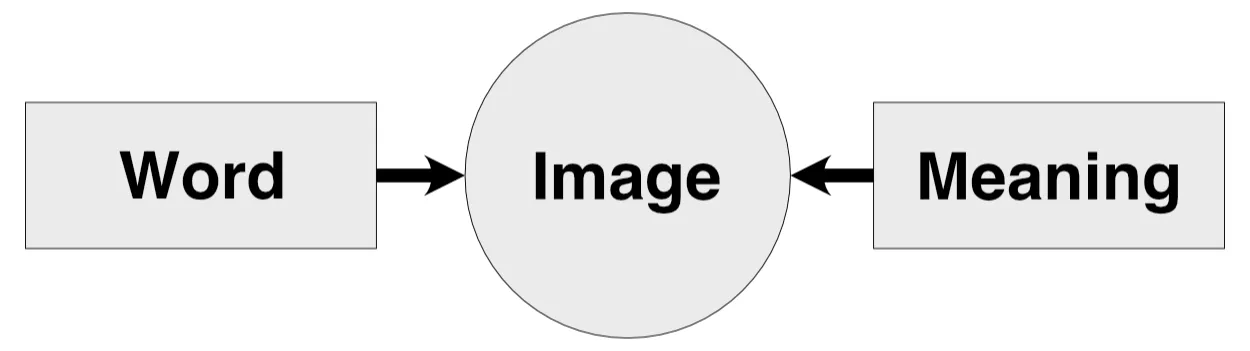
Here are the basic steps to memorize vocabulary words:
- Think of a picture (called a mnemonic image) to represent the sound of the word.
- Think of a picture that represents the meaning of the word.
- Then link the two mnemonic images into a compound image that links the mnemonics together.
Here’s a diagram:
Vocabulary Linking Method Example
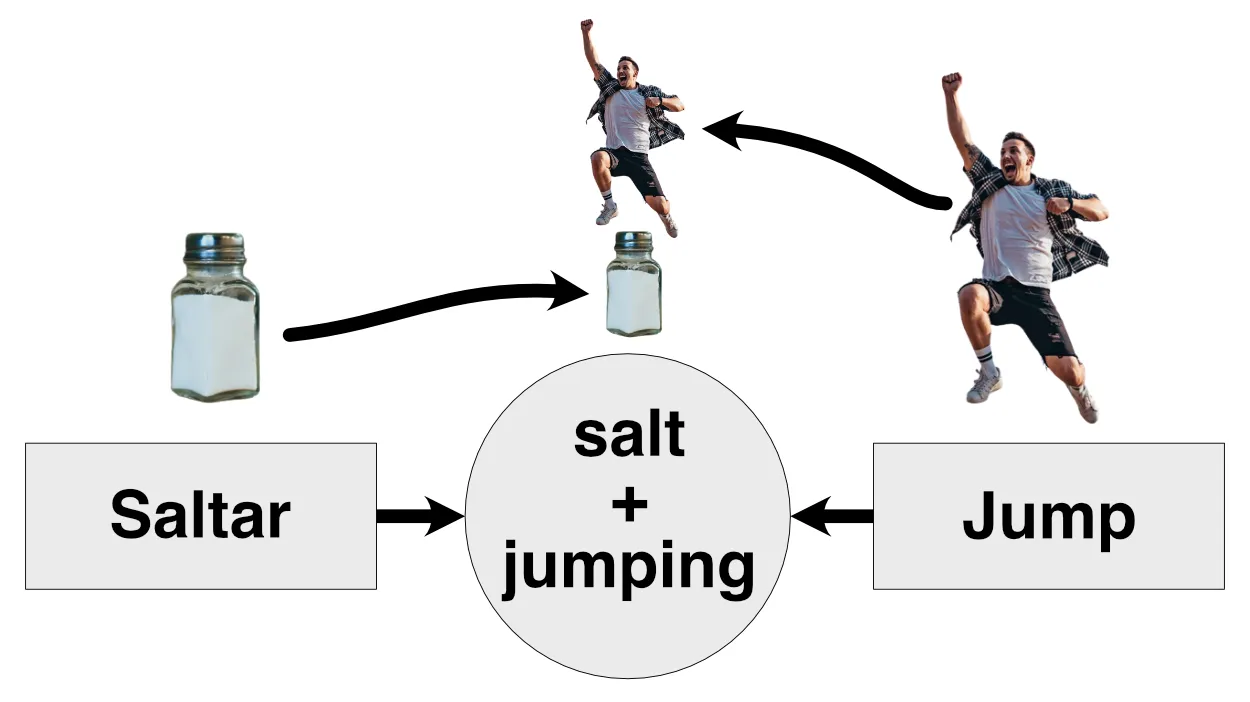
For example, if you want to remember the Spanish vocabulary word saltar, which means to jump, you could picture someone jumping over a salt shaker.
Saltar is the vocabulary word, and to jump is the meaning.
Let’s go through the steps:
- Think of a picture to represent the sound of the word. The word is saltar which sounds like “salt”, so the mnemonic image for the word could be a salt shaker.
- Think of a picture that represents the meaning of the word. The meaning is to jump so the mnemonic image could be “a person jumping”.
- Then link the two mnemonic images into a compound image that links the mnemonics together. The compound image here is “a person jumping over a salt shaker”.
The image of the salt shaker jumping encodes both the word and its meaning.
Finding the Meaning from the Word
When you hear the word “saltar”, the “salt” part of the word will remind you that someone was jumping over salt — so the word saltar means “jump”.
Finding the Word from the Meaning
When you want to think of the Spanish vocabulary word for “jump”, you can recall what the jumping person was doing, which was jumping over salt.
The mnemonic image should be enough to get you past the tip-of-the-tounge effect, where you know that you know a word, but just can’t quite recall it.
Advanced Vocabulary Example
Here’s a more advanced example on how to memorize vocabulary:
Sometimes you will come across abstract words, and it’s difficult to think of pictures to represent them.
Let’s use an example from a language that doesn’t have much in common with English. The Hebrew word for “porch” or “balcony” is mirpeset (מִרפֶּסֶת). There aren’t any words in English that sound like mirpeset, but you can start to break the word into parts to see if that helps.
Let’s break it into two parts: mir- and -peset.
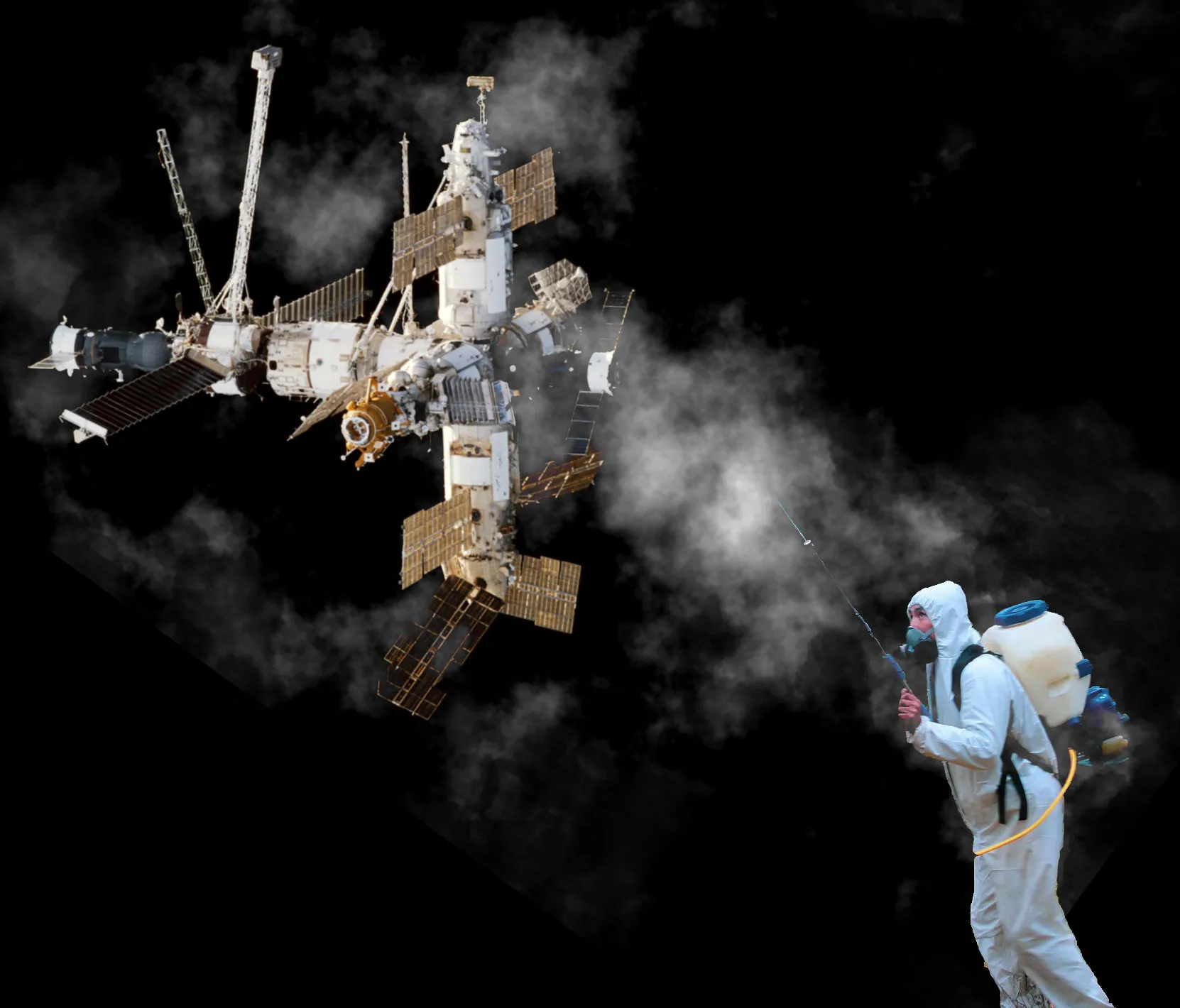
The first part of the word, mir sounds like the Russian space station, Mir.
The last part of the word, peset, sounds close to the English word “pest”. We could use an image of a pest control specialist.
So now we have two mnemonic images:
- Mir, the space station.
- Pest control specialist.
Now combine them into one image: a pest control specialist spraying the space station to clean up an infestation of space termites.
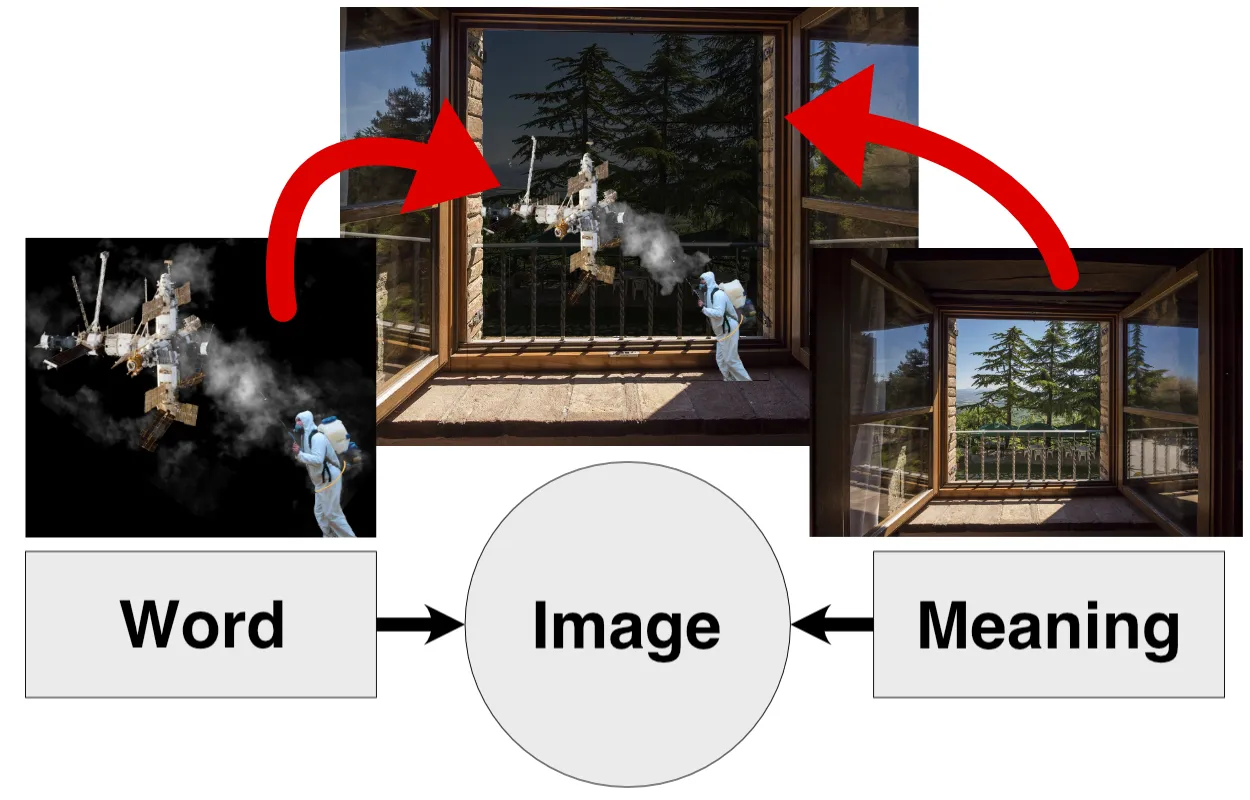
Remember that you need two images: one for the word’s sound (mirpeset) and another for word’s meaning. Here’s a reminder of the pattern:
We have the image for the sound of mirpeset (a pest control guy spraying Mir for bugs), and now we need an image for the meaning: a porch or balcony.
For that, I would visualize the image of the space station on a porch or balcony that you’re familiar with.
Here’s a summary:
- The word’s image is Mir and the pest control specialist.
- The meaning’s image is a porch or balcony.
- Connect the two together by imagining the word’s image linked to the meaning’s image in some way: the pest control on the space station is happening on a porch or balcony.
How to Keep the Mnemonic Images in Order
Notice that in the picture the space station is to the left of the pest control specialist. To keep images in order you can come up with a fixed pattern for placing images.
One method is to use the rule: “left-to-right or top-to-bottom”. Whatever images appear on the left or top come before the images on the right or bottom of the mnemonic scene. You can use any rule you want to indicate the order of the images, as long as you can remember the meaning.
How to Recall the Vocabulary Word
When you go to recall “the Hebrew word for porch”, let your mind go to the porch and look at the mnemonic image you’ve stored there. “Mir” and “pest control”. That should help you get past the tip-of-the-tongue effect so that you can recall the word.
When you hear the word mirpeset and want to know what the meaning is, break the word up and try to find the mnemonic images in your mind. The sound mir- should take you to the space station, the pest control guy, and the image that represents its meaning: a porch or balcony.
Different Mnemonics Work for Different People
Everyone’s brain tends to make images a little differently. Images that work for one person might not work for another.
For example, if you don’t know that Mir is a space station, then the example mnemonic above might not stick in your mind well. In that case, it would probably be better to make your own images. You could use “mirror” instead of a space station or whatever works for you.
Your images don’t have to make sense to anyone but yourself, so be creative!
Advanced Vocabulary Techniques and Examples
There are more tips on the How to Create Mnemonic Images page.
There are also many discussions about the topic here:
- How do I create mnemonic images for difficult, abstract words?
- Need help visualizing some abstract words
- How do I create mnemonic images for abstract words
- Visual dictionary from characters for abstract words
- Tip for remembering abstract words
- Creating images for syllables to recall abstract words
- Mnemonic images for common English words
- Tips for learning massive vocabulary with mnemonics
- Tarnation’s 500+ common words with mnemonic images
- Remembering abstract terms and concepts
- How to turn jargon/terminology/abbreviation into pictures which can be visualized
If you’re having trouble coming up with mnemonic images for words, check out the examples in the table below.
| Vocabulary Word | Mnemonic Image | Word Meaning | The Mnemonic Link |
|---|---|---|---|
| Arcane | arrrr + cane | secret or obscure knowledge | A pirate with a cane and a secret message. |
| Callous | callus on foot | Insensitive | The callus on the foot makes it less sensitive. |
| Sycophant | psycho + elephant | Someone who flatters | A psycho elephant that flatters people. |
| Vex | Tyrannosaurus vex | To annoy | An annoying Tyrannosaurus rex. |
| Venerable | vulnerable | Deserving of respect due to age | A vulnerable, venerable old person. |
| Insular | insulation | Having a narrow outlook or scope | A person that can’t see much because they are surround by insulation. |
| Gist | joust | The substance of a speech | Someone jousting while giving a speech. |
| Abut | a butt | Being next to | Your butt is next to something |
| Amiable | amigo-able | Friendly | Amigo means friend, the root word is the same |
| Adroit | a droid | Skillful | A skillful droid |
How to Memorize Spelling
You can also use image modifiers to help you with the spelling of a word. If you have trouble remembering whether the word ‘whether’ is spelled with one or two h’s you can link your image of the number 2 (a swan/hen (major system) to your image of the word ‘whether’. So this could be a cloud raining swans/hens. For alike sounding letters (f/v; t/d) separate modifiers must be created.
You can also look for some aspect of the word that stands out to you. For example, there is a spelling rule in English, “i before e, except after c”, that has some exceptions. To remember that the word “weird” is an exception, you can remember that “weird” has weird spelling.
How to Memorize Grammar
For an example of grammar memorization see the Esperanto Vocabulary page.
How to Memorize Word Gender
There are a couple of ways to attach gender information to words:
- Image modifiers
- Locations
An image modifier or tag is an extra image that changes the meaning of another mnemonic image. For example, if a noun is masculine you could attach an image of He-Man to it. If it’s feminine you could attach She-Ra to the image. Use whatever images you want to represent masculine, feminine, and neuter genders (depending on the language)
Information on the location-based method can be found on the Memory Town System for Languages page.
How to Memorize Pronouns
Pronouns can be memorized with the method of loci. Create a small memory palace and place the pronouns in order. Many languages follow a similar pattern:
| Singular | Plural | |
|---|---|---|
| 1st Person | [word] | [word] |
| 2nd Person | [word] | [word] |
| 3rd Person | [word] | [word] |
Sometimes there are formal and informal versions too, which you can fit in the table.
Place the words from the table in your memory palace. If there are different forms for other cases (genitive, accusative, etc.) create additional memory palaces.
How to Remember Verb Conjugations
Verb conjugations can be remembered with the method of loci. Figure out how many categories of verbs there are. Many European languages have three groups of verbs as well as irregular verbs. One way to do it is to create a small memory palace for each variant.
You can memorize verb conjugation tables in the same order as the pronoun tables. It’s easier to remember if you’re consistent. So if your order of pronouns was:
- 1st person singular
- 2nd person singular
- 3rd person singular
- 1st person plural
- 2nd person plural
- 3rd person plural
…you could put the verb conjugations in a different memory palace in the same order.
Spaced Repetition for Vocabulary Words
If you want to remember the vocabulary for the long-term, the next step is to review the words using spaced repetition. There are programs that can automatically remind you when the optimal time for recall is. Our memory palace app has spaced repetition features in addition to the memory palace management functionality. Anki flashcard software is another program that works well.
Related Discussions
Here are some discussions about how to memorize vocabulary:
- Many useful tips to learn massive vocabulary with mnemonics
- Study: Mnemotechnics in Second Language Learning
- Mnemonics for Spanish Vocabulary
- Creating Contexts for Vocabulary
- Mnemonics for Japanese vocabulary (pronunciations)?
- Memory Palace to memorise vocabulary
- Why use a memory palace for vocabulary?
- The Effect of the Integrated Keyword Method on Vocabulary Retention and Motivation
- Best way to organize a memory palace for vocabulary?
You can ask questions about memorizing vocabulary with memory palaces, the method of loci, mnemonics, and other memory techniques in the Art of Memory Forum.
