How to Memorize Numbers with the Major System
The Major System is a memory technique for memorizing numbers, playing cards, and other information. It works by converting numbers into sounds, which can then be converted into mental pictures or words that are easier to remember than the original data.
When combined with the memory palace technique, the Major System can be used to memorize numbers that are thousands of digits long. It’s also useful for memorizing decks of cards and creating peg lists.
In this guide, we’ll show you how to create your own list of Major System pegs and use them to memorize numbers of any length, even if the numbers are hundreds or thousands of digits long!
Tip: If you would like help with creating and using your Major System, ask questions in our free memory forum and we’ll be able to give you personalized assistance.
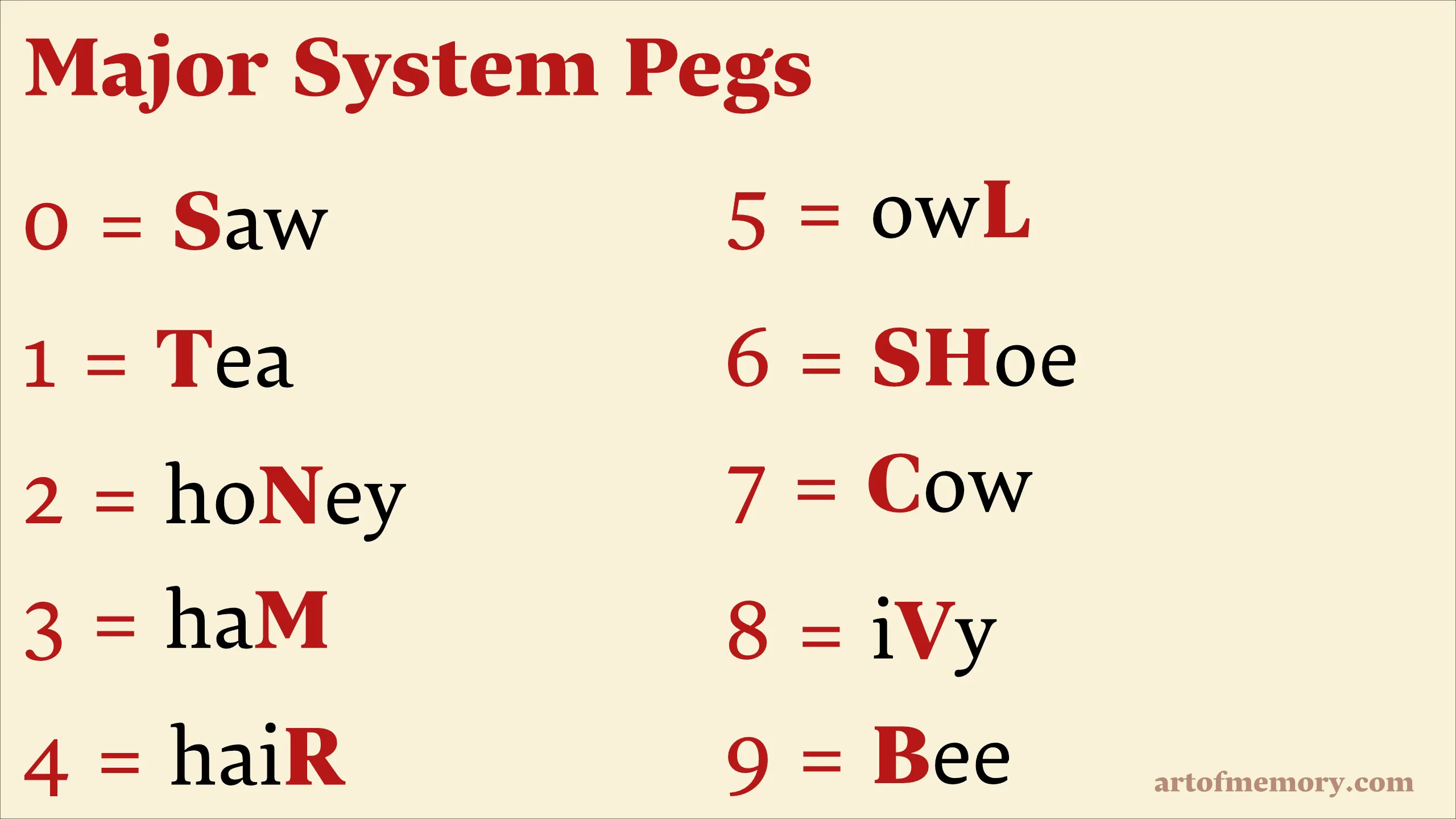
How the Major System Works
We’re going to cover the entire process below in detail, but the basic steps for using the major system are:
- Convert the digits of each number up to 99 into consonant sounds using a special code (explained in detail below).
- Create a memorable mnemonic word from the resulting consonant sounds. The word should be easy to visualize. You will end up with a mental dictionary of 100-110 mnemonic images.
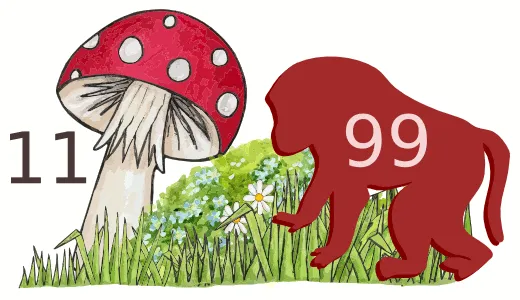
As an example, the number 11 might turn into the mnemonic image “toadstool” and the number 99 might turn into the mnemonic image “baboon”. When you want to remember 1199, you would create a mnemonic image based on the toadstool and baboon and place them into a mental location in a mind palace.
The process of memorizing abstract data like numbers can become a highly imaginative, artistic process.
Scroll down for instructions on how to create your own Major System images. We’ll also provide a complete list of Major System peg words that you can download for free.
Major System Video Explanation
If you’re having trouble understanding how the Major System works, read How to Memorize Numbers and watch the video below. You might also want to create a quick number shape system to learn the basic process of converting numbers to mnemonic images.
How to Create a Major System
The Major System has evolved over hundreds of years, so there are many varying ways to create your own system, and creating your own variations is okay.
In the technique’s most common modern form, each digit is associated with one or more consonants like this:
- Assign a consonant sound (not letter) to each digit.
- Use those letters to generate visual images that can be memorized in place of the numbers.
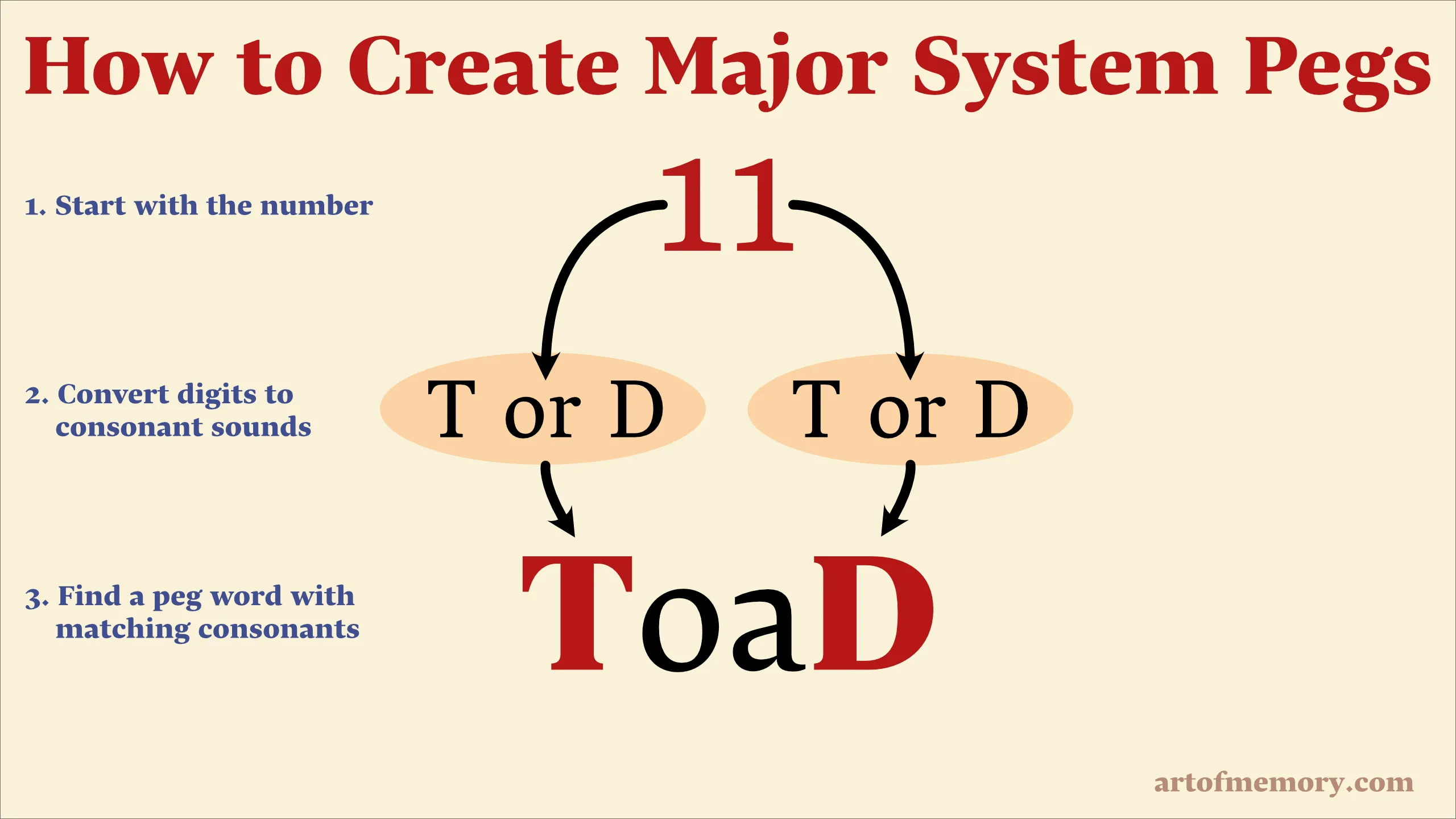
The digit 1 would be assigned the sound for “t” or “d”, so for the number 11, the consonant sounds would be T/D and T/D. (We’ll explain why those sounds are used, below.)
You would then look for a word where the first two consonant sounds in the word match the consonants for the number.
ToaDstool fits for 11, because the first two consonants are T and D.
Tip: Don’t worry if your word has extra consonants, like the word toadstool. Your set of Major System pegs will generally only cover the numbers 00-99. A second set of pegs can cover numbers 0-9. Those two sets of pegs can be used to memorize numbers of any length. Competitors at memory competitions sometimes also have a set of 1,000 Major System images for 000-999. It requires more effort to create the larger system, but it increases performance when memorizing long numbers. If you’re just starting out, create your 00-99 images first. You can expand it after you’re comfortable with the basics.
Other Major System words you could use for 11 are:
- DaTa (character from Star Trek)
- ToaD
- TuT
- DuDe
- DeeD
- DaD
- TaTToo
Note that the word tattoo has double letters. Because the major system works with sounds and not letters, double letters have no special meaning. “TT” becomes a single 1, not 11, because the “T” sound is only heard once.
Let’s take a closer look at how to assign the consonant sounds to digits.
Assigning sounds to digits
In the Major System’s most common form today, vowels and the consonants w, h and y are ignored. These can be used as “fillers” to make sensible words from the resulting consonant sequences.
The table below shows the most common way to assign sounds to digits.
| Digit | Consonants | Mnemonic |
|---|---|---|
| 0 | s, z, soft c | z is the first letter of zero. The other letters have a similar sound. |
| 1 | t, d | d & t have one downstroke and sound similar (some people include th here) |
| 2 | n | n looks something like 2 on its side and has 2 downstrokes |
| 3 | m | M looks like a 3 on its side and has three downstrokes |
| 4 | r | 4 and R are almost mirror images of each other, R is the last letter of “fouR” |
| 5 | l | L is the Roman Numeral for 50 |
| 6 | sh, soft ch, j, soft g, zh | g looks like an upside-down 6, cursive j looks kind of like a 6 |
| 7 | k, hard c, hard g, hard ch, q, qu | capital K looks like two sevens stuck together |
| 8 | f, v | cursive f looks like 8, v is a vocalize f (some people include th here) |
| 9 | p, b | P looks like a mirror-image of 9. b sounds similar look like a rotated 9 |
| Ignored | Vowel sounds, w,h,y | These sounds are ignored in the traditional Major System |
Here are some examples of how to use the table above to create Major System pegs:
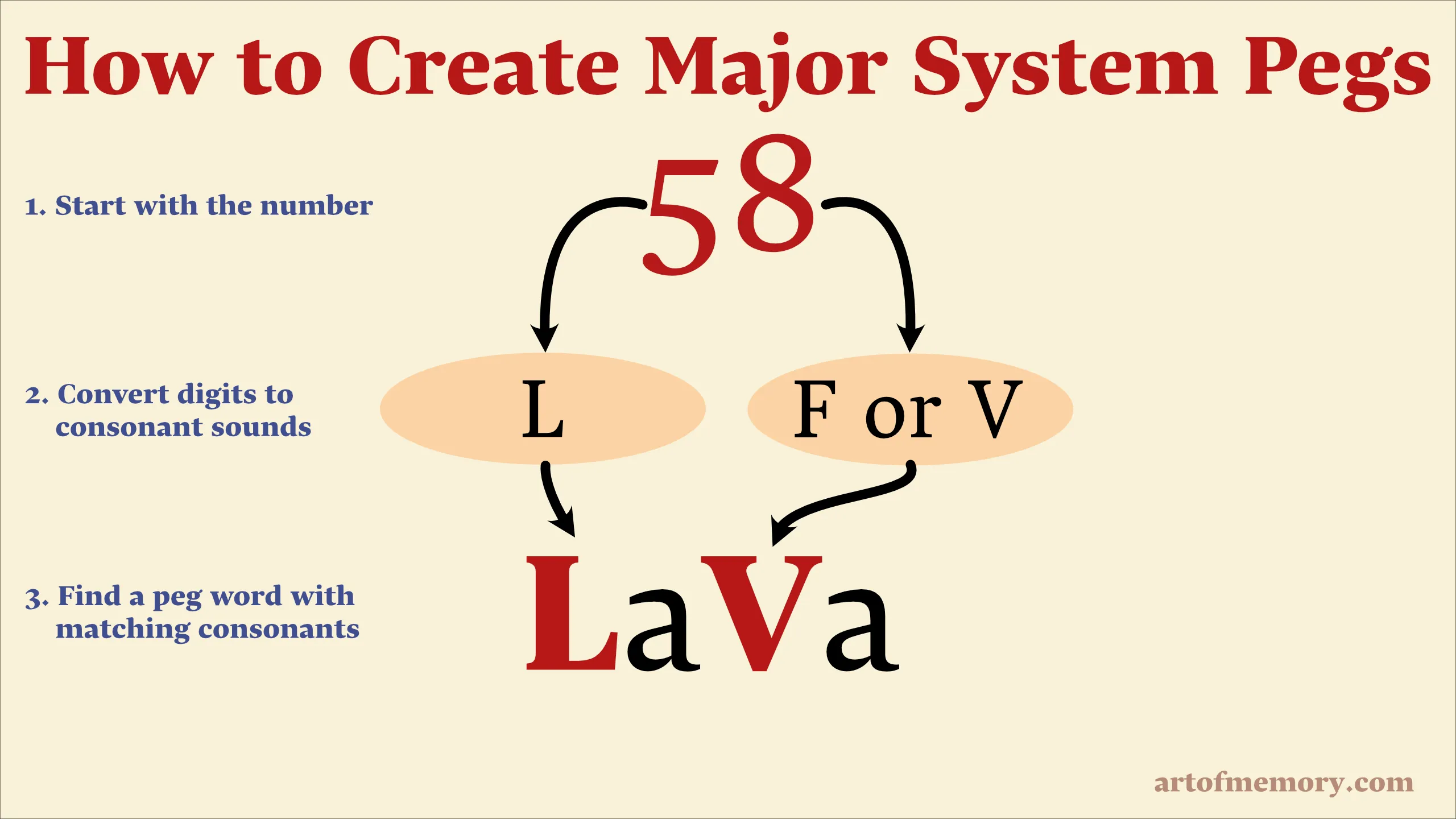
Here’s another example with the number 58:
Changing the Default Assignments
It’s very common for people to modify the table of assignments, so don’t hesitate to adjust it for your language or personal preferences.
The sounds can be matched to the digits in different ways as long as the system is consistent.
As an example, Gregor von Feinaigle’s system from 1808 looked like this:
- 0 = s, x, z
- 1 = t
- 2 = n
- 3 = m
- 4 = r
- 5 = l
- 6 = d
- 7 = c, k, g, q
- 8 = b, h, v, w
- 9 = p, f
Here are some other examples of Major System customization:
- The magician Derren Brown uses “f” and “v” for the digit
5, because the word “five” starts with “f” and contains a “v”. - Josh uses “b” for
6along with some other modifications - The Ben System is similar to the Major System in its use of consonants, but expands it with vowels in a similar way to Richard Grey’s method from 1730.
- The Dominic System uses both consonants and vowels, and uses the letters to suggest the initials of people.
- Harold Mangum uses phonetic sounds for 0 to 9 based on the most common form of the Major System, mentioned above: Suh, Tuh, Nuh, Muh, Ruh, Luh, Shuh, Cuh, Fuh, Puh.
- In the book Denk dich schlau!: Die besten Gedächtnistechniken für junge Superhirne, Steffen Bütow describes a Twin System that uses the following assignments based on similarities between the shapes of the written letters and digits: 0=D, 1=T, 2=N, 3=M, 4=K, 5=S, 6=G, 7=L, 8=B, 9=P.
Yanjaa uses the following consonant assignments:
- 0 = p
- 1 = t
- 2 = n
- 3 = m
- 4 = r
- 5 = s
- 6 = b
- 7 = L
- 8 = f/v
- 9 = g
Feel free to experiment!
The Difference Between Letters and Sounds
In the traditional Major System, the assignments for digits are sounds, not letters.
This can be confusing for speakers of languages like English that have letters which represent multiple sounds.
For example, in English, these words all use different letters to represent an “f” sound:
- Fire
- enouGH
- PHotograph
- stuFF
That short example shows at least four ways to write the “f” sound: f, ff, ph, and gh. In the Major System, all of those are treated the same (digit: 8), because they have the same sound.
Now try making an “f” sound like “fuhhhhh…” and compare it to a “v” sound like “vuhhhhh…” Notice that your mouth shape and tongue position are basically the same for both sounds. The difference is that with “f” you’re only using air, and with “v” you’re vibrating your vocal chords.
“F” is called a unvoiced consonant, and “V” is called a voiced consonant.
The Major System assignment table is based on pairs of unvoiced and voiced consonants:
- f and v
- t and d
- p and b
- sh and zh
- ch and sh
I recommend taking a moment to compare those sound pairs so you are familiar with the unvoiced and voiced versions. It will make it easier to remember the table of assignments.
As another exercise, compare your mouth shape and tongue positions for the following word pairs:
- Coast (unvoiced) and GHost (voiced)
- Car (unvoiced) and Gar (voiced)
All four of those words would map to numbers that start with the digit 7 — the important part is that they use the “k” and “g” sound. The letters don’t matter, only the sounds.
Premade Major System vs. On-the-Spot Conversion
Most people create a premade list of Major System peg words for numbers from 00-99. It’s also a good idea to have extra images for 0-9. With those 110 mnemonic images, you can memorize any number of any length.
Some people also create the mnemonic images on the spot, but that method is less effective than having fixed images. Your premade images can be kept in order by using the Method of Loci or Mnemonic Link System (a.k.a., Story Method).
Another use of the Major System is to create custom mnemotechnic words for the things that you are memorized. The mnemotechnic word(s) could be changed according to the thing to be memorized.
The Major System can be combined with a mnemonic peg system for remembering lists, and is sometimes used also as a method of generating the pegs. There is more information on how to do that below.
The Major System as a Peg List
You can create a peg list from your Major System images.
Here’s an example. If these are your first 5 Major System pegs:
- 00 = SauCe
- 01 = SeeDs
- 02 = SuNflower
- 03 = Sumo
- 04 = SaRdines
and you want to remember the countries with the highest populations in descending order:
- China
- India
- USA
- Indonesia
- Pakistan
you can create a mnemonic image for each country and mentally attach it to its corresponding number peg.
Here are some example country images using a memorable picture from each country:
- China = a panda bear is the national animal
- India = Taj Mahal
- USA = Statue of Liberty
- Indonesia = gamelan orchestra
- Pakistan = a markhor — the national animal of Pakistan has distinctive, memorable horns
The images above were chosen arbitrarily. You can create whatever mnemonic image reminds you of the country.
Memorizing the Peg List
Once you have a list of country-images, link each one to its corresponding peg:
- 00 = SauCe — link with panda bear
- 01 = SeeDs — link with the Taj Mahal
- 02 = SuNflower — link with the Statue of Liberty
- 03 = Sumo — link with the gamelan orchestra
- 04 = SaRdines — link with the markhor
For the first peg, 00, you could imagine a panda bear eating sauce or pouring the sauce on the panda’s head.
For the second peg, 01, you could imagine eating seeds while standing in front of the Taj Mahal.
For the third peg, 02, you could imagine a sunflower growing out of the Statue of Liberty’s head.
For the fourth peg, 03, you could imagine sumo wrestlers playing in a gamelan orchestra.
For the fifth peg, 04, you could imagine a markhor eating a can of sardines.
To recall the names of the countries in order, mentally walk through your numbers from 00 to 04.
Recalling the Peg List
The image for 00 is sauce, so you would try to remember what the sauce was doing. A panda was eating the sauce. What country is represented by a panda? China.
The image for 01 is seeds, so you would try to remember what the seeds were doing. You were eating them in front of the Taj Mahal. What does the Taj Mahal image represent? India.
You can keep going through the list like that, recalling the names of the countries in order.
You don’t have to stop at five items — a 00-99 Major System will give you 100 pegs. A 000-999 Major System will give you an additional 1,000 pegs!
History of the Major System
See the History and Evolution of the Major System for background on the technique.
Major System Software and Resources
Major System Lists
For pre-made Major System lists, please see the Major System Examples page. You can download the completed examples there or borrow ideas.
Here’s a free Major System template that you can use to create your major system images.
Software
Here are some tools that can help you find images for the Major System:
You can write your Major System list on paper, enter them in a spreadsheet, or use the Art of Memory Software, which has spaced repetition features.
Learn More
These pages contain further reading about the Major System:
- How to memorize a mnemonic number or card system
- Hexadecimal Major System
- How to memorise the Major System itself?
- Memory Improvement and Learning Information
- Pseudonumerology
These pages contain information about related topics, including the legendary PAO System, which can be used with the Major System:
- An Igbo Vowel-Consonant-Vowel System
- The Shaper System is a simpler alternative to the Major System that lets you create mnemonic images based on the shapes of the numbers themselves.
- The Dominic System is an alternative to the Major System.
- The Person-Action-Object (PAO) System allows you to fit more digits into each memory palace location.
- The Ben System is a more advanced system for memorizing numbers that works with 3-digit numbers (000-999) as well as playing cards and binary numbers in chunks of 10 digits at a time.
- We also have a long list of memory techniques that can give you an overview of various other methods.

