Eidetic Memory vs. Photographic Memory: Do They Exist?
Eidetic memory is the ability to keep a vivid picture of something in front of your eyes for a short time after it is gone, as if you were still looking at it. Researchers have reported it in a small share of children, the picture usually fades within a few minutes, and almost no adults show it.
It is not the same as a photographic memory, the idea of an exact and lasting picture you can call up and read at will, which no one has ever shown under controlled testing.
Photographic Memory Test
Do you think you have an eidetic or photographic memory? Our free photographic memory test is a ladder of short levels. The first ones are easy for anyone, each one asks for a little more, and the last ones are tasks that a real photograph in your head would make easy. Two misses end a run, and the result says which level you reached.

What Is Eidetic Memory?
An eidetic image is a mental picture that behaves almost like something you are still seeing. Alan Searleman, a professor of psychology at St. Lawrence University, describes how it differs from an afterimage and from an ordinary mental picture.
- It is not an afterimage. The dark spot you see after a camera flash moves around when you move your eyes, and it is usually a different color from the flash. An eidetic image stays where it is and keeps the colors of the original picture.
- It is not ordinary imagery. A picture of your bedroom that you call up from memory does not behave like this. An eidetic image fades on its own, part by part, and it is not possible to control which parts fade first.
- It is short-lived. Most eidetic images last from about half a minute to a few minutes. Blinking on purpose can wipe one out, and once it is gone, it rarely comes back.
People who have eidetic images are sometimes called eidetikers. They describe the picture as being out in front of them rather than in their head, but they rarely if ever mistake it for the real thing.

Eidetic, Photographic, HSAM and Trained Memory Compared
Four kinds of memory get mixed up in articles about remarkable memories. Only the last one is something you can choose to have.
| Kind of memory | What it is | Who has it | What the evidence says |
|---|---|---|---|
| Eidetic imagery | A vivid picture that seems to stay in front of the eyes for seconds or minutes after it is gone | A small share of children, almost no adults | Reported in studies, but researchers disagree about what it is, and it does not improve recall |
| Photographic memory | An exact, lasting picture you can call up and read details from at will | No one, as far as anyone has shown | Never shown under controlled testing |
| Highly superior autobiographical memory (HSAM) | Remembering what happened on almost any day of your own life | A very small number of people | Documented, but people with it mostly do no better than anyone else on ordinary memory tests |
| Trained memory | Memorizing with techniques such as the memory palace | Anyone who learns and practices them | Documented in memory competitions, where trained memorizers learn numbers, cards and names at speed |
Is Eidetic Memory Real?
Maybe, in children, but not in the way most people mean. An earlier edition of the Stanford Encyclopedia of Philosophy calls it “the rare, poorly understood, and controversial phenomenon known as eidetic imagery.”
Here is what the research says.
- It is mostly found in children. Studies of schoolchildren have found it in roughly 5 to 9 percent of those tested, such as 12 of 150 children in a 1964 survey by Ralph Haber and Ruth Haber. Most research finds it virtually absent in adults.
- It does not last. The images are said to persist for about four minutes at most, and once they have faded, children who had them recall no more detail than children who did not.
- Researchers do not agree on what it is. There is no scientific consensus on its nature, its definition or even its existence. Haber held that it is a real and distinct ability. Others, such as Gray and Gummerman in 1975 and Bugelski in 1979, argued that the reports are exaggerated descriptions of ordinary, if unusually vivid, visual memory.
- It is often inaccurate. Eidetic images are often sketchy, and eidetikers sometimes change details or add ones that were never there. Searleman writes that “the accuracy of many eidetic images is far from perfect,” which suggests that the images are rebuilt from memory like any other memory.
So even where eidetic imagery exists, it is not a photograph. Nicolas Rothen, Beat Meier and Jamie Ward, the authors of Enhanced memory ability: Insights from synaesthesia (2012), put it plainly:
It is important to mention that eidetic imagery is not photographic and hence does not generally benefit memory performance.
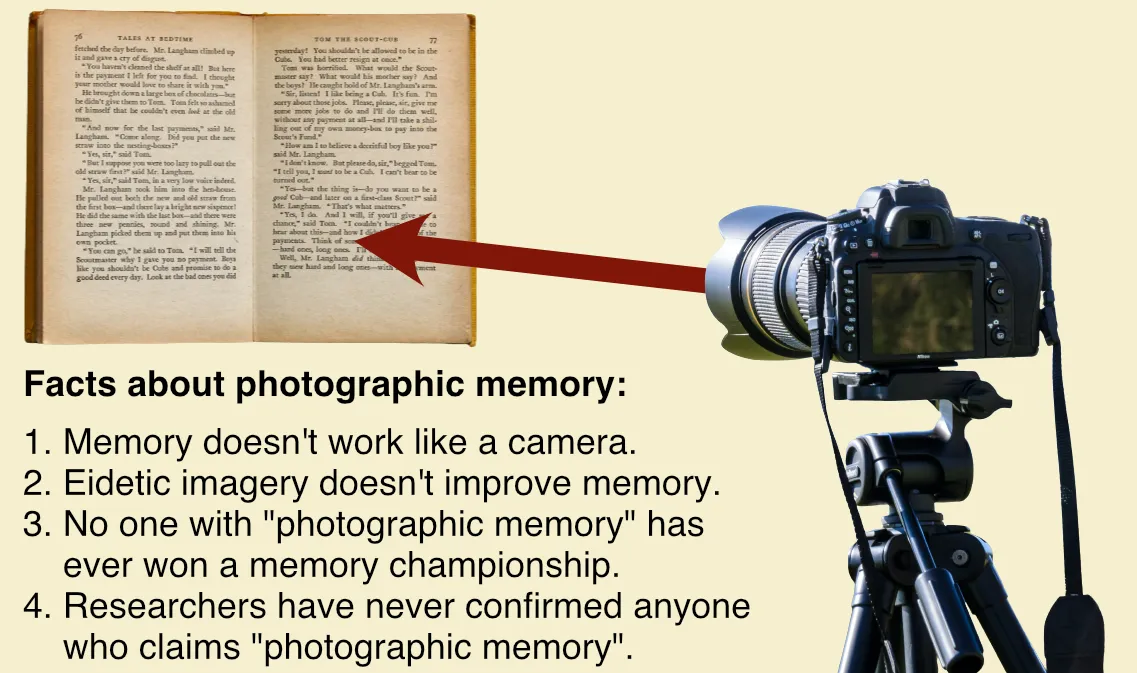
Does Photographic Memory Exist?
Photographic memory is the popular idea that some people can take a mental snapshot of anything, a page of text or a grid of numbers, and later read it back perfectly, as if from a photograph. There is no good evidence that anyone can.
Barry Gordon, a professor of neurology and cognitive science at the Johns Hopkins University School of Medicine, writes that “a true photographic memory in this sense has never been proved to exist.” Marvin Minsky, a co-founder of MIT’s Artificial Intelligence Lab, went further in The Society of Mind, calling the stories “unfounded myths.”
Another sign is who has never turned up. The World Memory Championships have run since 1991, and the Memory League World Championships draw the fastest memorizers in the world, yet no one with a photographic memory has ever competed at either. The top competitors all use the same memory techniques described on this site. As Skeptoid concluded after reviewing the research, “the difference between ordinary memory and exceptional memory appears to be one of degree.”

Can You Develop an Eidetic Memory?
No. No training has been shown to create eidetic imagery or a photographic memory, and the eidetic imagery reported in children is almost never found in adults.
What you can develop is the kind of memory that looks photographic from the outside. People memorize thousands of random digits at memory competitions and a shuffled deck of playing cards in under 20 seconds on Memory League. A 2003 brain imaging study of leading memory competitors found that their intelligence and brain structure were ordinary, and that nine of the ten used the method of loci, better known as the memory palace.
Their secret is memory techniques. A memory palace turns a list into a walk through a place you know, and a mnemonic system turns numbers and cards into pictures that are easy to place along that walk. These techniques work for long-term memory as well as short-term. Almost anyone can learn them with some practice, and our how to learn memory techniques page shows where to begin.

Famous Claimed Cases
A few cases come up again and again as proof of a photographic memory. None of them has been confirmed.
Elizabeth and the Random-Dot Stereograms
In 1970, the Harvard vision scientist Charles Stromeyer III and a colleague published a paper in Nature about a young woman known as Elizabeth. They tested her with random-dot stereograms, which the vision scientist Béla Julesz developed at Bell Labs. A random-dot stereogram is a pair of patterns that each look like noise, but that show a shape floating in depth when the left eye sees one and the right eye sees the other. Elizabeth was said to have seen one pattern, and then, after it was gone, to have fused it with the other from memory and seen the shape.
That would have been the first real proof of a photographic memory. But other scientists, Blakemore and colleagues among them, raised concerns about how the study was done, and no one has repeated the feat since. Joshua Foer, author of Moonwalking with Einstein, summed up what happened next: “Stromeyer married her, and she was never tested again.”
The Search for Another Elizabeth
In 1979, the researcher John Merritt published the results of a photographic memory test he had placed in magazines and newspapers across the United States, hoping to find someone like Elizabeth. By his estimate, about a million people tried it. Thirty sent in the right answer, and he visited fifteen of them at home. With him watching, none of them could repeat the feat.
Solomon Shereshevsky
Solomon Shereshevsky was a Russian journalist whom the neuropsychologist Alexander Luria studied for about thirty years. He could repeat what was said at a work meeting word for word without taking notes, and memorize long formulas and tables in minutes. But his memory ran on vivid pictures from his synesthesia, and he described using techniques such as the method of loci. Luria did not clearly separate his natural ability from those techniques, so his case does not show a photographic memory.
Extraordinary Memory Abilities Guide
Learn more about extraordinary memory abilities.
- Photographic Memory Test 🔥
- Superior Autobiographical Memory (Hyperthymesia) 🔥
- Aphantasia and Memory 🔥
- Synesthesia and Memory
- How to Improve Short-Term Memory
- Solomon Shereshevsky
- The Mystery of Solomon Shereshevsky
- Hannibal Lecter, Mnemonist
- Another Look at Highly Superior Autobiographical Memory (HSAM)
- Savants and Memory Competitions
- How to Use Sherlock's Mind Palace
- Memory Grid: A Visual Memory Game
- Vault Heist: A Spot the Difference Memory Game
- Dual N-Back: A Working Memory Game
- Discussions About Memory Techniques, Exams, Studying, and Homework
- Ask Questions in Our Forum (free)
How to Test Your “Eidetic” or “Photographic” Memory
Look at something you could not remember any other way, such as a grid of random digits, for a few seconds. Then look away and read it back in an order you did not practice, such as up a column or along a diagonal. With a photographic memory, you would simply read the picture in your head. A random-dot stereogram is the classic eidetic version of the same check, since only an exact image of the first pattern lets you see the shape.
Our free photographic memory test runs both kinds of check for you, with a random-dot overlay in place of the stereogram, starting easy and getting harder level by level. If you think you have an “eidetic” or “photographic” memory, please test yourself on Memory League too. If you can get to level 10 in the numbers game without practicing or using memory techniques, you have a chance at becoming the first person ever verified to have a photographic memory!
Frequently Asked Questions
Is eidetic memory real?
Eidetic imagery has been reported in studies of children, but researchers still disagree about what it is, and some think the reports are vivid descriptions of ordinary visual memory. Where it does appear, it does not make memory more accurate. A lasting, exact photographic memory has never been shown under controlled testing.
What percentage of people have eidetic memory?
Studies of schoolchildren have found it in roughly 5 to 9 percent of those tested. It is close to absent in adults, so there is no reliable figure for the population as a whole.
Can adults have eidetic memory?
Almost never. A few researchers have claimed to find it in adults, but most studies find it virtually absent after childhood. The most famous adult case, a woman known as Elizabeth who was reported in 1970, was never confirmed, because she was never tested again and no one has repeated her feat.
How can I test for an eidetic or photographic memory?
Look at a grid of random digits for a few seconds, then look away and read it back in an order you did not practice, such as up a column. With a photographic memory you would simply read the picture in your head. Our free photographic memory test does this for you, with levels that start easy and climb to tasks like that one.
Can you train yourself to have an eidetic memory?
No training has been shown to create eidetic imagery or a photographic memory. What you can train is a much better memory. Memory competitors use techniques such as the memory palace to learn long numbers, decks of cards and lists of names, and almost anyone can learn the same techniques.
