A Guide to Mnemonic Peg Lists
A peg list is a mnemonic technique for memorizing lists. It’s an alternative to the method of loci, also known as the memory palace technique.
The basic principle of peg lists is that you can take a ordered list of information that you already know and use it to memorize new things while keeping them in order.
A Peg List Example Using the Alphabet
For example, if you know the English alphabet from A to Z, then you have 26 “pegs” that you can use to remember at least 26 things in order.

The first step is to associate each letter with an animal that starts with that letter. Here’s a partial list:
- A — Alligator starts with A
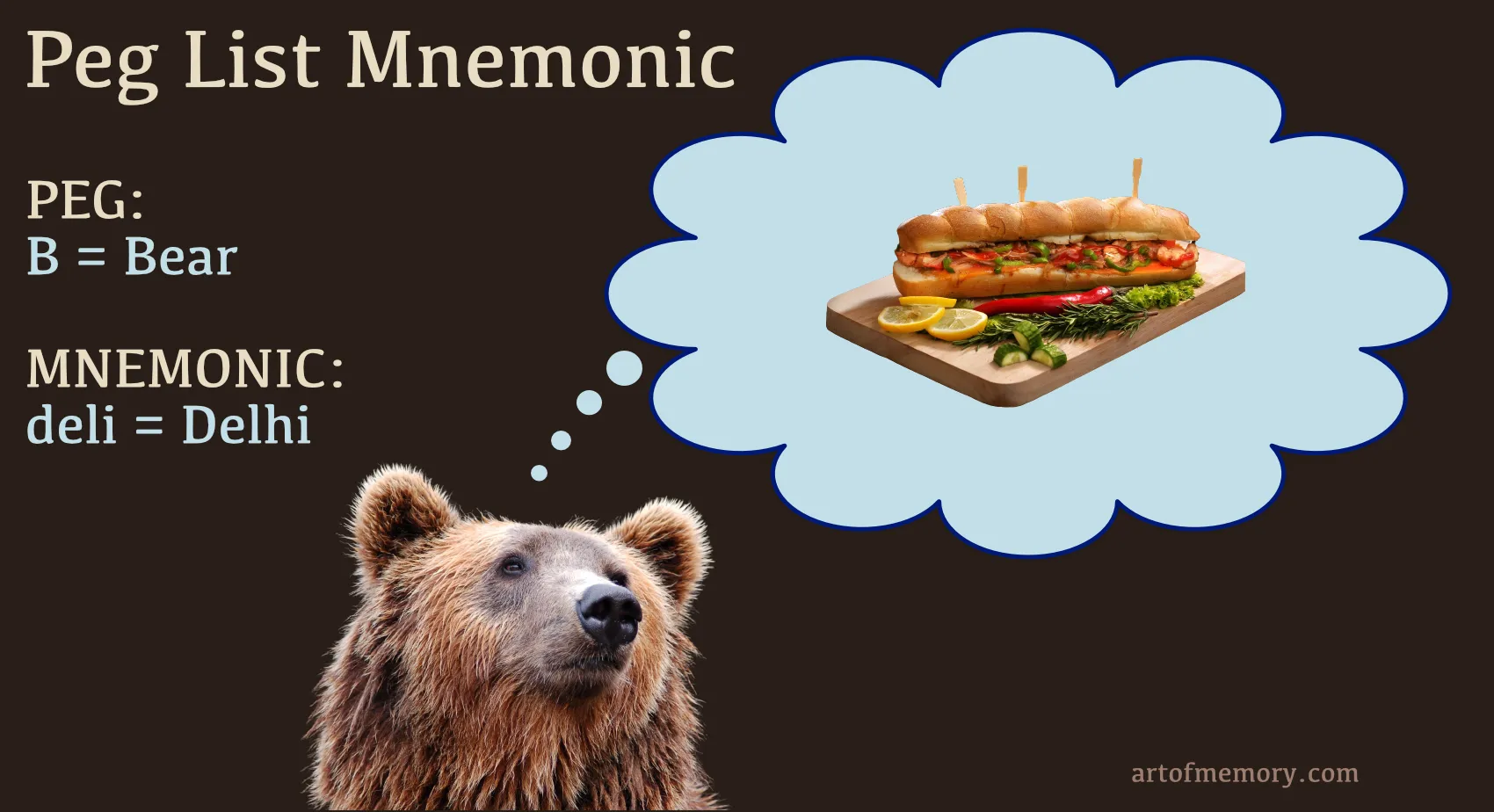
- B — Bear starts with B
- C — Cow starts with C
- D — Duck starts with D
- etc.
If you want to try the technique, you can complete the lists in this post as an exercise. You can also download a free template from the alphabet peg lists page. A peg list is reusable, so you’ll be able to use it in your daily life, even after you’re done reading this article!
If you’re new to memory techniques, you might want to also read about mnemonic images and how to create mnemonic images, which will show you how to come up with good mental pictures.
Once you have 26 alphabet animal pegs, you can remember facts by attaching each fact to an animal peg.
Let’s say the facts you want to memorize are the largest cities in the world in order from largest to smallest.
- Tokyo
- Delhi
- Shanghai
- São Paulo
- etc.

The next step is to imagine each of the animals interacting with something that reminds you of that city.
For example, to remember that Tokyo is the largest city in the world (as of 2022), I’d attach the first peg to something that reminds me of Tokyo. For me, that would be something like ramen — I’d picture an alligator (peg #1) eating ramen (representing Tokyo).

You can continue down the list of animal pegs and cities.
The second largest city in the world is Delhi. If remembering “India” is enough to recall the name of the city, you could link peg #2 (a bear) with anything that reminds you of India, for example, the Taj Mahal.
Another way to create the mnemonic image is to base it on the sound of the city: “Delhi” sounds like “deli”, so you could imagine that the bear is eating a deli sandwich.

Continue going through the list of facts, attaching each one to a peg item.
Then, to recall the facts, mentally walk through the list of pegs. You already know the alphabet in order, so you can recite the alphabet to find the names of the animals.
As you think of each animal, try to remember what it was doing.
- The alligator (letter A) was eating ramen, which will remind you of Tokyo — the largest city in the world.
- The bear (letter B) was at the Taj Mahal (or eating a deli sandwich), which will remind you of Delhi — the second largest city in the world.
- and so on.
Number Pegs
Any list of information that you know in order can be used as a peg list.
Since you already know numbers in order, they can also be used as pegs.
An easy way to create the peg images for numbers is to use the number rhyme system.
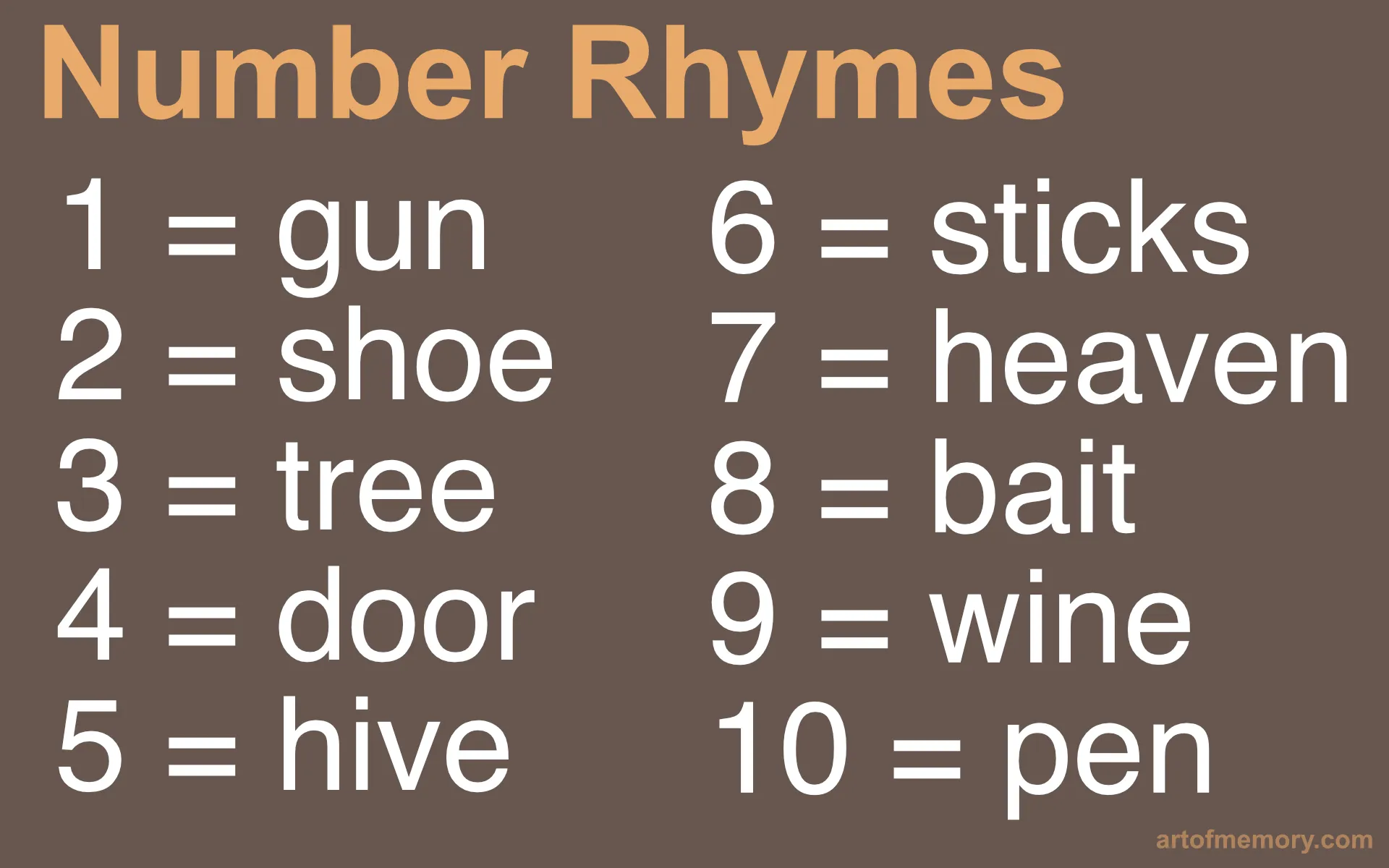
Each number from 1 to 10 can be given a rhyming mnemonic keyword. Here’s a sample peg list based on number rhymes:
- one - gun
- two - shoe
- three - tree
- four - door
- five - hive
- six - sticks
- seven - heaven
- eight - bait (for fishing)
- nine - wine
- ten - pen
If you have a list of things to memorize, like a shopping list, you can associate each item of the list with a number rhyme image. So if your shopping list is: carrots, milk, bread, eggs, rice, etc., make associations like this:
- One is “gun” — imagine a gun shooting a pile of carrots, the first item on your shopping list.
- Two is “shoe” — imagine cleaning your muddy shoe with a bottle of milk.
- Three is “tree” — imagine bread growing on a tree.
- Four is “door” — imagine throwing eggs at a door.
- Etc.
Once you’ve associated each item in your shopping list with a number peg, you’ll be able to mentally walk through the numbers, recall the rhymes (“what was the gun shooting?”), and recall the item (“carrots”).
The number shape system can also be used to create pegs.
Peg List System for Memory League Images
Simon Orton came up with a peg list system that works well in the Memory League Images Game.
Learn More
Here are some pages where you can learn more improving your memory with peg lists:
- The Alphabet Peg System page explains how to use alphabets as peg lists.
- The Shaper System expands on basic number shapes to create 100 pegs.
- Mnemonic linking can help with combining multiple mnemonics.
- Using stories can help you store more than one fact in each location.
- The Major System can be used to create 1,000 or more number pegs.
