How to Build a Memory Palace
A Memory Palace is an imaginary location in your mind where you can store mnemonic images. The most common type of memory palace involves making a journey through a place you know well, like a building or town. Along that journey there are specific locations that you always visit in the same order.
Occasionally, you’ll hear the memory palace technique being called “the method of loci.” Loci is just Latin for locations, referring to the locations in a memory palace. (singular: locus, plural: loci)
Welcome! Create a free account to learn how to get started with memory palaces and memory techniques!
You can also download our free ebook, Learn the Art of Memory.
How to Create a Memory Palace
- Step 1: For your first memory palace, try choosing a place that you know well, like your home or office.
- Step 2: Plan out the whole route — for example: front door, shoe rack, bathroom, kitchen, living room, etc. Some people find that going clockwise is helpful, but it isn’t necessary. Eventually, you will have many memory palaces. You will also be able to revise the memory palace after you test it a few times, so don’t worry if it’s not perfect on the first try.
- Step 3: Now take a list of something that you want to memorize — a shopping list of 20 items is a good place to start: carrots, bread, milk, tea, oats, apples, etc.
- Step 4: Take one or two items at a time and place a mental image of them in each locus of your memory palace. Try to exaggerate the images of the items and have them interact with the location. For example, if the first item is “carrots” and the first locus in your memory palace is the front door, picture some giant carrots opening up your front door.
- Step 5: Make the mnemonic images come alive with your senses. Exaggeration of the images and humor can help.
- Step 6: See the instructions below.
(Here’s a detailed how-to on creating palaces.)
If you want to commit the items to your long term memory, use Spaced Repetition, and they will stick in your memory.
Step-By-Step Example
According to Roman legend, the memory palace technique was invented by Simonides of Ceos about 2,500 years ago. The technique is also known as the method of loci.
This page contains an example memory palace using a modern scene from the small Greek village where Simonides was born. It is quite possible that Simonides himself walked down these paths.
Create the Memory Palace
We will create our memory palace in this location:

Tip: You can use our memory palace app to help create, organize, and review your mind palaces!
Once you have a location for your memory palace, find a sequence of locations to store memories. These locations will never change. You will always review them in the same order. If you don’t already have a preference, it may be better to arrange your locations in a clockwise direction, top to bottom, or left to right. Don’t worry about that for now though. In this example, the locations are chosen for you.

Notice how they follow a coherent journey around the location:
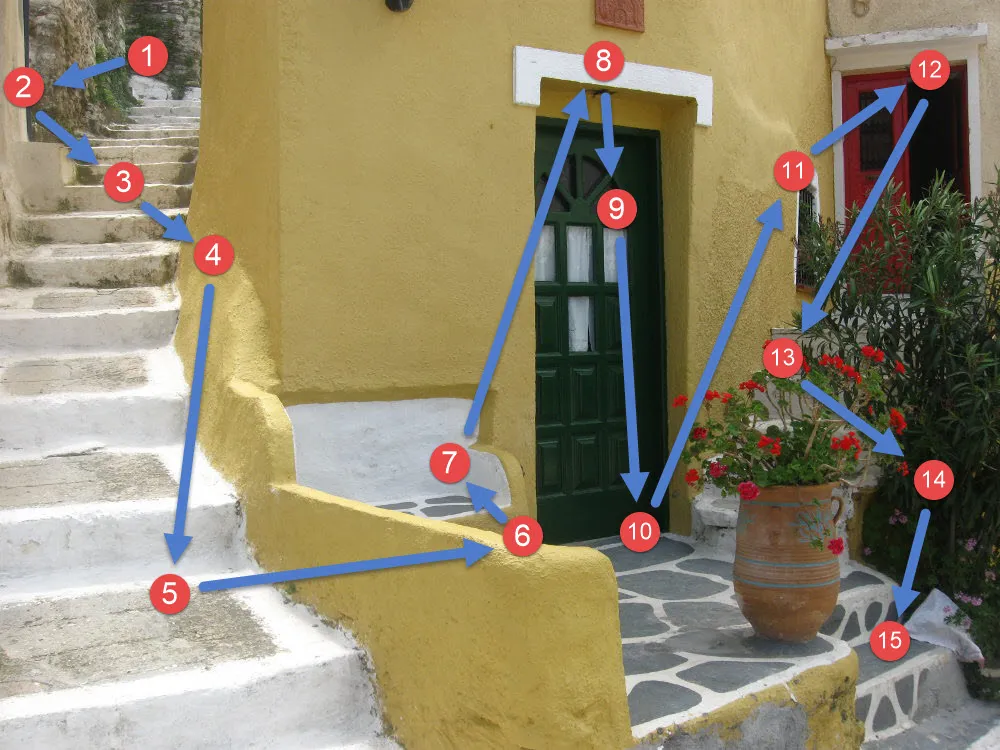
You aren’t limited to just a narrow area. You can use the same technique by walking around your town or a building, and choosing locations along the way.
In this example, the locations are:
- The top of the stairs
- The ledge next to the stairs
- The stairs next to the ledge
- The slanted part of the wall
- The bottom step
- On top of the wall
- On the bench
- In the hole above the door
- Peeking through one of the windows
- In front of the door
- Hanging from the bars over the window
- Inside of the doorway
- Among the red flowers
- Hiding in the bushes
- On the step
It is helpful to mentally walk through the journey several times until you can do it with your eyes closed. Also try mentally walking through the journey backwards to be sure that you can do it in both directions.
Placing the Memories
Basically, you’ll make visual representations (mnemonic images) for each of the things that you want to remember.
In this tutorial, we’ll use our example mind palace to memorize the first 15 elements in the periodic table of elements.
Let’s create and place images!
First Location
Here is a reference image for the first few locations:

The first location in our memory palace is at the top of the stairs on the left.
The first element in the periodic table is hydrogen. We need a mnemonic image to represent hydrogen. It could be the Sun (which is mostly hydrogen), or maybe water (H20).
The process of creating mnemonic images becomes much easier with practice, so don’t be discouraged if it takes you a little effort in the beginning to think of something memorable.
I would imagine a picture of the Sun at location #1.
Second Location
The second location is the ledge next to the stairs. The second element is helium. Imagine a helium balloon tied to the stone at position #2.
Third Location
The third location is on the stairs next to the ledge. The third element is lithium. An image for lithium could be a lithium battery.
You could picture a battery rolling down the stairs.
Fourth Location
The fourth location is on the sloping base of the wall. In this place, we will store a memory that represents beryllium.
The word “beryllium” reminds me of a berry. I would picture a berry being smashed against the wall.
Fifth Location

At the fifth location (the step), we will place an image to represent boron.
“Boron” sounds like “boar”, so place an image of a boar there.
Sixth Location
The sixth element is carbon. A good mnemonic image for “carbon” is “car”. Imagine a car racing along the ledge.
Seventh Location
The seventh element is nitrogen. An image that sounds like “nitrogen” is “knight”. Imagine a jousting knight racing across the step on a horse.
Eighth Location

The eighth element is oxygen. When I think of oxygen, I imagine a space suit. I would picture an astronaut with an oxygen tank floating at position #8.
Ninth Location
Element #9 is fluorine. “Fluorine” sounds like “fluoride”. I would imagine cleaning the windows with a toothbrush and toothpaste.
Tenth Location

The tenth element is neon. Picture a neon sign at the foot of the door. Maybe you are smashing a neon sign on the stones there.
Eleventh Location

The eleventh element is sodium. You could picture a salt shaker embedded in the wall or being pushed out of the window.
Twelfth Location
The twelfth element is magnesium. I would imagine a magnesium fire starter in the darkened doorway.
Thirteenth Location

The thirteenth element is aluminum. Imagine aluminum foil wrapped around the plant.
Fourteenth Location
The fourteenth element is silicon. Picture silicon computer chips at position #14.
Fifteenth Location
The fifteenth element is phosphorous. All that a mnemonic image needs to do is get you past the tip of the tongue effect. “Phosphorous” has a similar beginning as “Fozzie Bear”. Picturing Fozzie Bear should be enough to help you recall phosphorous, at least after mentally walking through the memory palace a few times.
Common Problems
These are the questions that come up most once people have built their first palace.
Images Slip Off Their Loci
If you put two or three images on each locus, you may find that you remember which images go together but not where in the journey they were. The fix is to give every locus a hook, one feature that the first image has to touch. If the locus is the front steps, the image lies on the stone of the steps. If it is a mailbox, the image climbs out of the mailbox. At an electrical box, the image is wired into the box, and at a willow tree, it hangs in the branches. An image tied to a feature of its locus stays where you put it.
How Many Loci Fit in One Room
More than most beginners expect. A whole room can be one locus, or ten, as in the Roman room, or more again if you use small features like a light switch, a shelf and a radiator as loci of their own. The Rhetorica ad Herennium, a Roman handbook on public speaking, advises loci of moderate size, because a locus that is too large makes its images vague, and one that is too small seems to have no room for them. Ten loci per room is a good start, and you can add more wherever there is space for an image.
How Many Images to Put on Each Locus
One image per locus is the simplest, and it is where to start. People who memorize cards and numbers quickly often put two or three images on each locus, so that a deck of cards needs fewer loci. The Ben System, for example, puts three images on each locus.
When I tried both, I found two images per locus easier and faster than three. Two images join into one scene without much effort, such as a dog tearing apart a wooden throne. A third image means working out what the second one is doing to it. With one image for each card, two images per locus take 26 loci for a deck, against 18 for three, and the extra loci are worth it until combining images comes quickly.
Which Way the Journey Should Turn
If you place the images on each locus from left to right, plan your journeys to go clockwise, or to turn right. When a journey turns left, the last image on a locus ends up on the far side from the next locus, and the order starts to feel backwards. It is a small thing to get right when you design a palace, and an annoying one to live with afterwards.
You Need a Palace Right Now
You don’t need a planned palace to remember a few things. Look around the room you are in and pick a handful of features in order, as in the Roman room, or use any picture you can walk around in your mind, as with virtual memory palaces. A palace built on the spot fades quickly, which is fine for a list you only need today.
Video Tutorial
Here’s a video that explains how to memorize numbers using memory palaces:
Once you’ve built your first memory palace, you can keep practicing with free games. Waypoints asks you to visit numbered points in order after the numbers disappear, and Errand Driver has you memorize a shopping list and then drive around town to the shop that sells each item.
Learn More About Memory Palaces
Memory Palace Guide
Learn more about how to use memory palaces.
- Learn How to Use Sherlock's Mind Palace 🔥
- The Roman Room Method
- Do Memory Palaces Really Work?
- How to Create Virtual Memory Palaces 🔥
- Books About Memory Palaces
- How to Reuse Memory Palaces
- List of Memory Techniques for Studying
- How to Use Spaced Repetition
- How to Use the Method of Loci
- Advanced Memory Palace Tips
- Memorize Numbers with a Memory Palace
- Memory Palace for Language Learning
- Simonides of Ceos and the Method of Loci
- Palace Run: A Memory Palace Game
- Waypoints: A Method of Loci Puzzle
- Errand Driver: A Shopping List Memory Game
Additional resources:
