Do Memory Palaces Really Work? What the Research Says
Yes. The memory palace, also called the method of loci, is one of the most studied memory techniques there is, and the research says it works for ordinary people as well as for memory champions. This page sums up three studies, what they show and what they don’t, and a five-minute way to try it yourself.
What the Research Found
Memory Champions Use a Method, Not a Special Brain
In 2003, Eleanor Maguire and her colleagues studied people known for outstanding feats of memory in competitions. They gave them neuropsychological tests, including measures of intelligence, and scanned their brains. The superior memorizers did not have exceptional intelligence, and their brains did not differ in structure from anyone else’s. What set them apart was the way they learned. They used a spatial strategy, and while they memorized, their brains engaged regions such as the hippocampus, which matters for memory and for spatial memory in particular.
In other words, the champions showed no structural differences in their brains. They had learned a method, and it was a spatial one, the kind a memory palace is built on.
Six Weeks of Training Changed Beginners’ Memories
In 2017, Martin Dresler and his colleagues took the question further. First they compared 23 memory athletes from the top fifty of the memory sports world rankings with people matched for age, sex, intelligence and handedness. Seventeen of the athletes were also given 72 words to learn, and they recalled 70.8 of them on average twenty minutes later, against 39.9 for the people they were matched with.
Then the researchers took 51 people who had never used a memory technique and split them into three groups. A third of them practiced the method of loci for 30 minutes a day over 40 days. Another third trained their working memory with a different exercise, and the rest did no training. After the six weeks, the memory palace group had improved far more than either of the other groups, and they were still ahead when they were tested again four months later.
Their brains changed too. Brain scans showed that the connections between the networks the researchers measured had shifted toward the pattern found in the memory athletes, and across all 51 people in the study, the more someone’s connections came to resemble the athletes’, the more their memory had improved.
It Helped People with Depression Recall Good Memories
In 2013, Tim Dalgleish and his colleagues tried the method with people who had depression, some in an episode and some in remission. Depression makes it harder to bring positive memories to mind, so one group was taught to store a set of positive, self-affirming memories along a memory palace. A comparison group grouped the same kind of memories into meaningful sets and rehearsed them.
After a week of training, both groups recalled their memories almost perfectly. On a surprise test a week after that, the memory palace group still recalled them, while the rehearsal group remembered significantly fewer. There is more about this study in the method of loci as a depression treatment.
Who Memory Palaces Work For
The beginners in these studies were not chosen for talent. Dresler’s trainees had never used a memory technique before, and within six weeks their memory for word lists had improved more than that of either comparison group. That makes the memory palace a good fit for anyone who needs to remember things in order: a shopping list, the points of a speech, vocabulary or facts for an exam. You can see how memory athletes take it further on the mental athletes page.
None of the three studies looked at aphantasia, in which people picture little or nothing in the mind’s eye. If that describes you, treat the memory palace as an experiment, and see the page on aphantasia for more.
The Limits
The research is encouraging, but it is worth knowing what it does not show.
- It takes practice. Dresler’s trainees practiced for 30 minutes a day for six weeks. A memory palace works on the first try, but it gets fast and reliable only with use.
- The samples were small and narrow. The training study had about seventeen people in each group, all of them young men.
- The studies measured memory for numbers, faces, word lists and personal memories. They don’t show that a memory palace makes you better at reasoning or problem solving, or that it helps with material you never put in a palace.
- A palace stores items in order. It is less useful for ideas you need to understand rather than recall, and not everything you learn needs to go in one.
- Images fade if you never revisit them. For anything you want to keep, review the palace on a schedule, as described in spaced repetition.
Try It in Five Minutes
You can test the technique on yourself right now. Here is a list of five things: a hammer, a pineapple, a violin, a candle and a goldfish.
- Pick a room you know well, and choose five places in it in order, such as the door, a chair, a window, a table and a lamp.
- Put one item in each place, and make the picture strange and vivid. The hammer is smashing the door, the pineapple is sitting in the chair wearing sunglasses, and so on.
- Spend a few seconds on each picture, then look away from this page for a minute.
- Walk through the room in your mind and write down what you find in each place.
- Try it again tomorrow without looking back at this page.
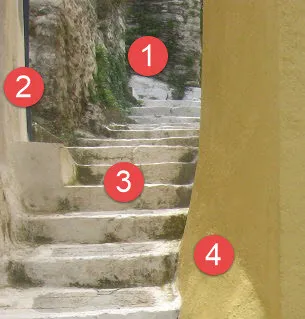
Most people are surprised by how easy the second step makes the fourth. The guide to building a memory palace shows how to go from five places to a full palace, with a worked example in a Greek village:
Sources
- Dalgleish, T., Navrady, L., Bird, E., Hill, E., Dunn, B. D., & Golden, A.-M. (2013). Method-of-loci as a mnemonic device to facilitate access to self-affirming personal memories for individuals with depression. Clinical Psychological Science, 1(2), 156–162.
- Dresler, M., Shirer, W. R., Konrad, B. N., Müller, N. C. J., Wagner, I. C., Fernández, G., Czisch, M., & Greicius, M. D. (2017). Mnemonic training reshapes brain networks to support superior memory. Neuron, 93(5), 1227–1235.
- Maguire, E. A., Valentine, E. R., Wilding, J. M., & Kapur, N. (2003). Routes to remembering: The brains behind superior memory. Nature Neuroscience, 6(1), 90–95.
Memory Palace Guide
Learn more about how to use memory palaces.
- How to Build a Memory Palace 🔥
- Learn How to Use Sherlock's Mind Palace 🔥
- The Roman Room Method
- How to Create Virtual Memory Palaces 🔥
- Books About Memory Palaces
- How to Reuse Memory Palaces
- List of Memory Techniques for Studying
- How to Use Spaced Repetition
- How to Use the Method of Loci
- Advanced Memory Palace Tips
- Memorize Numbers with a Memory Palace
- Memory Palace for Language Learning
- Simonides of Ceos and the Method of Loci
- Palace Run: A Memory Palace Game
- Waypoints: A Method of Loci Puzzle
- Errand Driver: A Shopping List Memory Game
