Roman Room Method: How to Use the Roman Room System
The Roman room system is a kind of memory palace that fits inside a single room. You picture a room you know well, choose ten places around it, and visit them in the same order every time. Then you put one mnemonic image in each place, and walking around the room in your mind brings the list back in order. It won’t give you an eidetic memory, but it is the quickest way I know to remember a short list without writing it down.
Where the Roman Room Comes From
Storing images in a building is an old idea. The Rhetorica ad Herennium, a Roman handbook on public speaking written in the first century BC, tells its readers to set their images against backgrounds, and it gives as examples “a house, an intercolumnar space, a recess, an arch, or the like”. A furnished room, walked the same way every time, is that advice on a small scale.
I learned the version on this page from Mind Performance Hacks by Ron Hale-Evans. Hack #4 in the book, Stash Things in Nooks and Crannies, makes a memory palace out of one room, and it was the first memory palace I ever built. The walk below is my version of it.
The Ten Places in a Roman Room
Stand in the doorway of a room you know well, such as your living room or a cafe you visit often. Then go around the room clockwise, starting in the corner nearest you on the left:
- The near left corner
- The left wall
- The far left corner
- The far wall
- The far right corner
- The right wall
- The near right corner
- The doorway, where you are standing
- The ceiling
- The floor in the middle of the room
Here is the same room from above. The small box at the bottom is the door, and the arrows show that place 9 is up on the ceiling and place 10 is down on the floor.
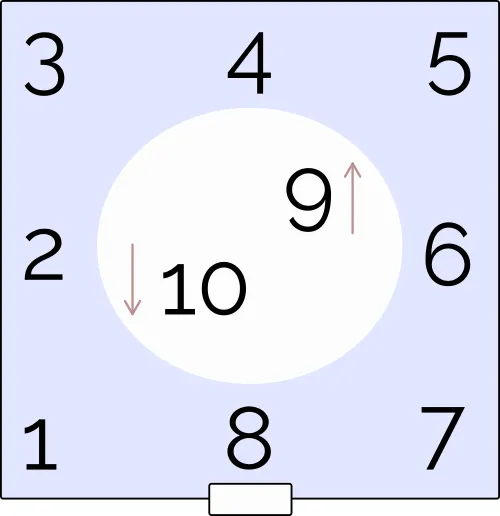
Give each place something solid to hold an image, like a table in the corner, a picture on the wall, a window or a couch. Walk the ten places in your mind a few times, forwards and backwards, until you can do it without thinking. You only build the room once, and after that it is ready whenever you need it.
I still use my first ten-place room every day for quick things like shopping lists. I prefer to build these rooms in large spaces like restaurants, cafes, halls and old buildings, because each place is then big enough to hold an elephant or a pterodactyl without shrinking everything down. I put up to three images in each place.
Three Worked Lists
Each of these lists uses the room above. The images are only suggestions. Ones you make up yourself will stick better, especially if they are strange, funny or a little disgusting.
A Shopping List
Milk, eggs, bread, bananas, coffee, rice, tomatoes, soap, batteries and flowers:
- A cow stands in the near left corner, filling a bucket with milk.
- Eggs are smashed all over the left wall and dripping down it.
- A loaf of bread as tall as a person leans in the far left corner.
- Someone has nailed bunches of bananas across the far wall.
- A coffee pot in the far right corner is boiling over.
- Rice is pouring out of the light switch on the right wall.
- Tomatoes are piled up in the near right corner, and the bottom ones have burst.
- You slip on a bar of soap in the doorway.
- Batteries are stuck to the ceiling, sparking.
- The floor in the middle of the room is covered in flowers.
The First Ten US Presidents
George Washington, John Adams, Thomas Jefferson, James Madison, James Monroe, John Quincy Adams, Andrew Jackson, Martin Van Buren, William Henry Harrison and John Tyler. Here each image sounds like the name:
- A washing machine (Washington) shudders in the near left corner.
- A huge Adam’s apple (Adams) bobs on the left wall.
- A chef (Jefferson) is cooking in the far left corner.
- A mad son (Madison) is drawing on the far wall.
- Marilyn Monroe stands in the far right corner.
- A smaller Adam’s apple, wearing a “junior” badge, bobs on the right wall.
- A car jack (Jackson) is lifting the near right corner of the room.
- A van is burning (Van Buren) in the doorway.
- A very hairy son (Harrison) hangs from the ceiling.
- A tiler (Tyler) is laying new tiles on the floor.
The Planets
Mercury, Venus, Earth, Mars, Jupiter, Saturn, Uranus and Neptune. Eight items need only the first eight places, so the ceiling and floor stay empty:
- A thermometer full of mercury has shattered in the near left corner.
- The Venus de Milo stands against the left wall.
- A globe spins in the far left corner.
- Mars bars are stacked against the far wall.
- A giant striped ball, as big as you can picture, fills the far right corner (Jupiter, the largest planet).
- A hula hoop circles around the right wall (Saturn’s rings).
- A spinning top lies on its side in the near right corner (Uranus spins on its side).
- Neptune’s trident blocks the doorway.
When you want the list back, stand in the doorway in your mind and walk the room. Each place hands you its image, and each image gives you the item.
When a Room Beats a Journey
A full memory journey through a house or a town holds far more than ten items, and it is what memory athletes use for long numbers and decks of cards. The single room still wins in a few cases:
- When the list is short. Ten places are plenty for errands, the main points of a talk or a few things to pack.
- When you need a palace right now. You can build one on the spot by looking around the room you are standing in.
- When the list is for today only. A room you use every day for lists you can forget keeps your longer journeys free for things you want to keep. There is more on that in how to reuse memory palaces.
For more than ten items, walk out of the door into the next room and carry on with places 11 to 20. At that point you are building a journey, and the guide to building a memory palace explains how to plan one.
Practice the Walk
To learn more about the technique behind the Roman room, read about the method of loci, Sherlock’s mind palace and Moonwalking with Einstein. You might also be interested in this forum discussion of the difference between memory palaces, memory journeys, mind palaces and Roman rooms.
