10 Memory Tips to Accelerate Your Learning
Get your notepad or memory palace ready — here are 10 quick tips that can help you improve your memory and boost your learning!
1. Use pictures and imagination
An easy way to remember new information is to use visual pictures to link it to something that you already know. These mental pictures are called mnemonic images.
For example, if you need to remember to buy bananas at the supermarket, picture giant bananas raining inside the supermarket. When you arrive at the supermarket, you’ll be able to scan your memory to find the image of the giant bananas, and you’ll remember the shopping item.
The Number Shape System is an example of how you can remember numbers by linking them to something you already know.
The images can supercharge your memory even further if you use stories to link the images together.

2. Exercise boosts memory
There is significant evidence that exercise improves memory — even if it’s just a single workout!
A single, moderate workout may immediately change how our brains function and how well we recognize common names and similar information, according to a promising new study of exercise, memory and aging. The study adds to growing evidence that exercise can have rapid effects on brain function and also that these effects could accumulate and lead to long-term improvements in how our brains operate and we remember.

Check out these discussions about the memory benefits of exercise:
- “30 Minutes of Aerobic Exercise Supercharges Semantic Memory”
- A single bout of acute aerobic exercise helps recover from mental exhaustion
- “How exercise keeps your brain healthy and protects it against depression and anxiety”
- How exercise might “clean” the Alzheimer’s brain
- “Dance training is superior to repetitive physical exercise in inducing brain plasticity in the elderly”
Read more about exercise and memory.
3. Use acrostics
An acrostic mnemonic is a kind of poem that you can create out of the first letters of words.
A good example is a mnemonic for the order of planets, which is:
- Mercury
- Venus
- Earth
- Mars
- Jupiter
- Saturn
- Uranus
- Neptune
If you take the first letter of each planet, you can create a new sentence:
My Very Educated Mother Just Served Us Nachos.
That sentence is easier to remember than the planet names by themselves.
You can create your own acrostics by inventing a new sentence from the first letters of each fact that you want to remember.

4. Take breaks while studying
There is evidence that brief, wakeful resting can help with memorization.
Our group and others have demonstrated that a 15-min period of eyes-closed rest following encoding enhances memory for both procedural and declarative memory tasks, compared to an equivalent period spent completing a distractor task. Other recent studies have demonstrated that post-learning rest enhances subsequent memory for spatial and temporal information, facilitates insight into a complex problem, and enhances auditory statistical learning. These memory effects can be maintained for a week or more after the rest intervention. Together, these observations suggest that even during wakefulness, memory is preferentially consolidated during offline states characterized by reduced attentional demands.
Here’s more about an effortless way to improve your memory:
When trying to memorise new material, it’s easy to assume that the more work you put in, the better you will perform. Yet taking the occasional down time – to do literally nothing – may be exactly what you need. Just dim the lights, sit back, and enjoy 10-15 minutes of quiet contemplation, and you’ll find that your memory of the facts you have just learnt is far better than if you had attempted to use that moment more productively.

When you’re resting, don’t check your phone or do other tasks — it’s better to rest completely:
Although it’s already well known that we should pace our studies, new research suggests that we should aim for “minimal interference” during these breaks – deliberately avoiding any activity that could tamper with the delicate task of memory formation. So no running errands, checking your emails, or surfing the web on your smartphone. You really need to give your brain the chance for a complete recharge with no distractions.
Read more about rest and memory.
5. Get enough sleep
Studying right before going to sleep appears to boost memory.
If you go to sleeping consciously knowing that you will be tested on the information the next day, it can improve your recall.
[Brain measurements] found that the “test is coming” group spent more time in deep, slow-wave sleep than did the group not anticipating a test. Slow electrical waves act as a replay button, causing the hippocampus to reactivate new memories and synchronizing the neocortex so that it accepts them into long-term storage. This expectant group also had more “sleep spindles,” bursts of electrical activity that prime networks in the cortex to store memories arriving from the hippocampus and to integrate them into existing knowledge, which makes retrieval easier.
Lack of sleep or interrupted sleep can be detrimental to memory, so be sure to get a good night’s sleep as often as possible.

There is some evidence that short naps of as little as 10 minutes can boost cognitive performance.
The 10-minute nap produced immediate improvements in all outcome measures (including sleep latency, subjective sleepiness, fatigue, vigor, and cognitive performance), with some of these benefits maintained for as long as 155 minutes. The 20- minute nap was associated with improvements emerging 35 minutes after napping and lasting up to 125 minutes after napping. The 30-minute nap produced a period of impaired alertness and performance immediately after napping, indicative of sleep inertia, followed by improvements lasting up to 155 minutes after the nap.
Read more about sleep and memory.
6. Try peg lists
Peg lists can help you remember lists of information. First, create a list of pegs, like this list of images that rhyme with numbers:
- one - sun
- two - shoe
- three - tree
- four - door
- five - hive
- six - sticks
- seven - heaven
- eight - gate
- nine - sign
- ten - pen
Now that you have a list of pegs, take a list of items that you want to remember, and imagine each item in your list interacting with one peg. If you’re remembering a shopping list and the first item on the list is milk, then imagine pouring milk on the sun (“sun” rhymes with “one”). If the second item on your list is lemons, imagine putting lemons in a shoe (“shoe” rhymes with “two”), and so on. To recall the list, recite the numbers from 1 to 10, convert each number to its rhyming image, and then recall what the image was doing.
You can also create pegs based on number shapes or letters of the alphabet.
7. Create a mind palace
Sherlock’s mind palaces really work! It’s the same technique that mental athletes use in memory competitions to perform feats like memorizing 80 random digits in less than 20 seconds or tens of thousands of digits of pi!
A mind palace, or memory palace, is an imaginary place in your mind where you can store memories. You create a mnemonic image for each fact you want to remember and then place each image in a location in your mind palace. To recall the data, you mentally walk through your mind palace and convert the pictures back into facts.
To learn the technique, see our separate tutorial on how to build a memory palace.
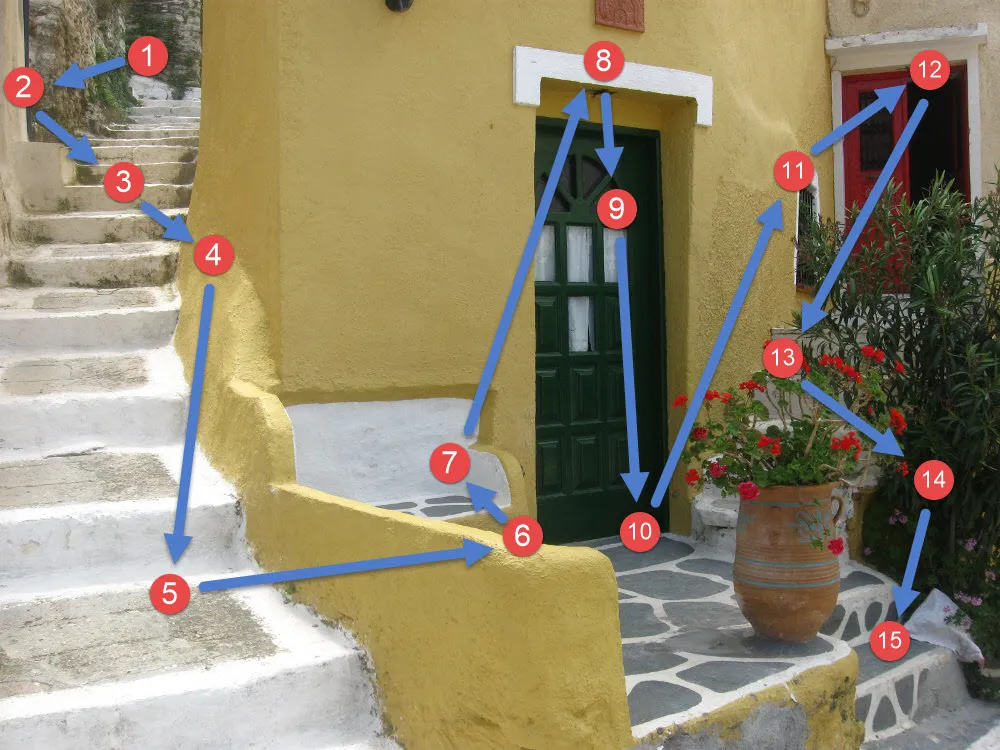
8. Eat healthily
According to Harvard Health, “research shows that the best brain foods are the same ones that protect your heart and blood vessels”.
They recommend foods like green, leafy vegetables, fatty fish, berries, and walnuts.
Read more about foods to improve memory.

9. Take a walk in nature
There is some evidence that nature can have beneficial effects on memory and stress reduction.
New study finds that short-term memory is improved 20% by walking in nature, or even just by looking at an image of a natural scene.
…These results replicated a previous study by Berto (2005) 3 who found that just viewing pictures of natural scenes had a restorative effect on cognitive function. People’s performance was soon restored by picture of trees, fields and hills, but not by streets, industrial units or even complex geometric patterns.

Read more about nature and memory.
10. Play memory training games
Try some memory training games, especially ones that teach memory techniques while you’re practicing.
Photographic memory doesn’t exist, but these memory techniques are probably the closest you can get.
You can find out how to learn advanced memory techniques on the getting started page. Be sure to sign up for our free memory forum so you can ask questions and get personalized memory training advice.
