Learn How to Use Sherlock's Mind Palace Technique
The mind palace technique is a method for memorizing large amounts of information by placing facts into locations inside of an imaginary “palace” in your mind. The palace can be any space that you are familiar with, like your home, school, workplace, or neighborhood. It can even be a virtual space, like a painting, computer game, or a scene that you invent yourself.
There’s a great TV show called Sherlock that features the mind palace technique in several episodes.
In episode 2 of season 2, called The Hounds of Baskerville, Sherlock Holmes utters the famous line:
“Get out. I need to go to my mind palace!”
Watson, his sidekick, groans and says to another character:
“Mind palace — it’s a memory technique sort of a mental map. You plot a map with the location — it doesn’t have to be a real place — and then you deposit memories there, and theoretically you can never forget anything. All you have to do is find your way back to it.”
Here’s a video clip of Sherlock’s famous mind palace scene:
Does the Mind Palace Technique Work?
First, does the mind palace technique actually work?
The answer is yes — mind palaces work amazingly well, especially for long lists of information!
“Mind palace” is another term for memory palace, also known as the method of loci. The technique has been used since prehistoric, hunter-gatherer times and by the Ancient Greeks and Romans. Cultures that didn’t have access to nearly unlimited amounts of paper, like we do today, needed to use other methods for remembering things.
For example, the Ancient Romans used mind palaces to memorize information, including speeches and rhetoric.
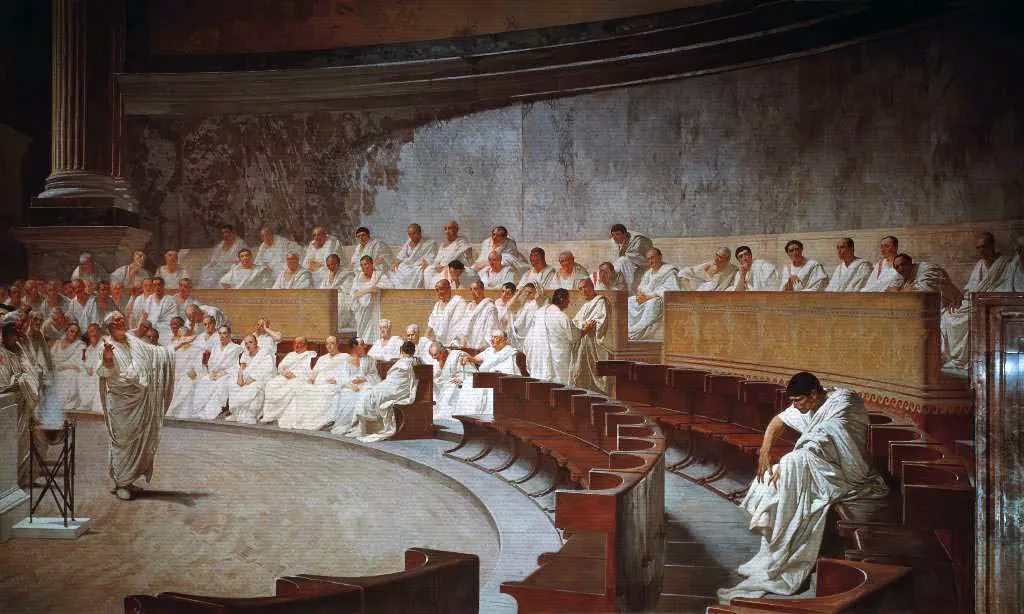
Today, in the 21st century, mind palaces are used by busy students, professionals, and memory champions to memorize vast amounts of information quickly.
Experience the Limits of Human Memory!
Tip: If you’re interested in seeing what is possible with mind palaces, check out the Memory League Leaderboard.
Memory League is a platform where you can train your brain and compete in real-time, online memory competitions with other players.
Some example feats that people have accomplished using mind palaces (and related memory techniques) on Memory League include:
- memorizing 80 random digits in less than 13 seconds
- memorizing a shuffled deck of cards in less than 13 seconds
- memorizing the names and faces of 30 random people in less than 40 seconds
- memorizing 50 random words in less than 35 seconds
- memorizing 30 random pictures in order in less than 10 seconds
If you’re interested in becoming a mental athlete, start with our how to learn memory techniques page. Even if you don’t think you have a naturally good memory, you are probably going to amaze yourself, your friends, and your family!
Here is one of the world’s fastest memorizers using a mind palace to perfectly memorize 30 random pictures in less than 10 seconds on Memory League:
Memory Palace Guide
Learn more about how to use memory palaces.
- How to Build a Memory Palace 🔥
- Learn How to Use Sherlock's Mind Palace 🔥
- How to Create Virtual Memory Palaces 🔥
- Books About Memory Palaces
- How to Reuse Memory Palaces
- List of Memory Techniques for Studying
- How to Use Spaced Repetition
- How to Use the Method of Loci
- Advanced Memory Palace Tips
- Memorize Numbers with a Memory Palace
- Memory Palace for Language Learning
- Simonides of Ceos and the Method of Loci
- Palace Run: A Memory Palace Game
How to Create a Mind Palace Like Sherlock
Mind palaces are often created in places that you know well, like your home, workplace, school, parks, stores, or anywhere that you’re familiar with. It’s also possible to create virtual mind palaces from pictures, which is what we’re going to do below.
Tip: If you’re interested in watching Sherlock episodes that include mind palaces, some episodes to check out are The Hounds of Baskerville (season 2, episode 2), The Abominable Bride (2016 special episode), and His Last Vow (season 3, episode 3).
For this example, we’ll use a photo of the Sherlock Holmes Museum in London.
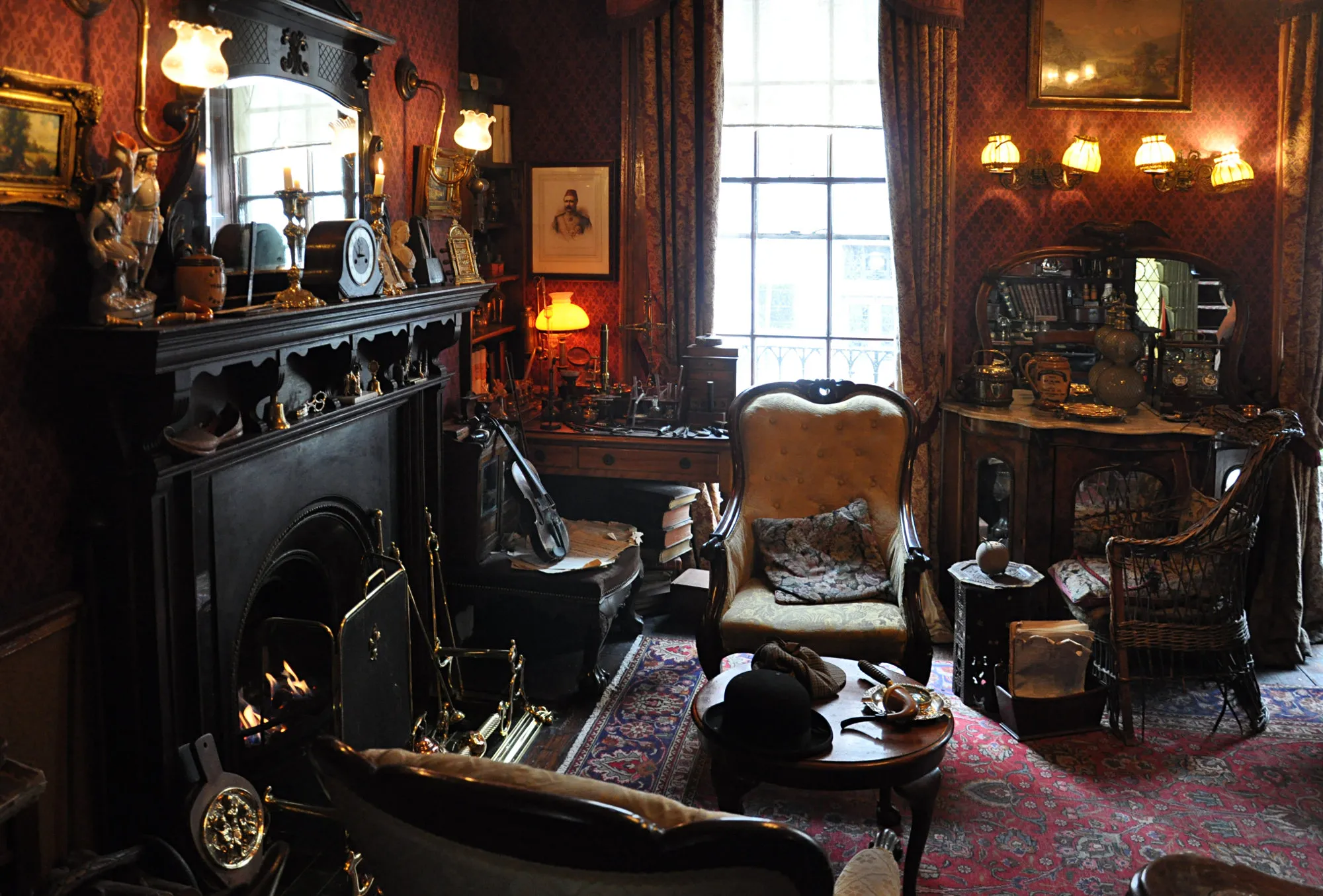
Here are the four steps to memorize information with a mind palace:
1. Create the Mind Palace Locations
First, we’ll pick some locations in the room to create a journey. I find it easiest to generally try to go from left-to-right and from top-to-bottom.
When you have a cluttered room like this, it’s possible to create many locations, but to keep this tutorial simple, we’ll make only 10 locations.
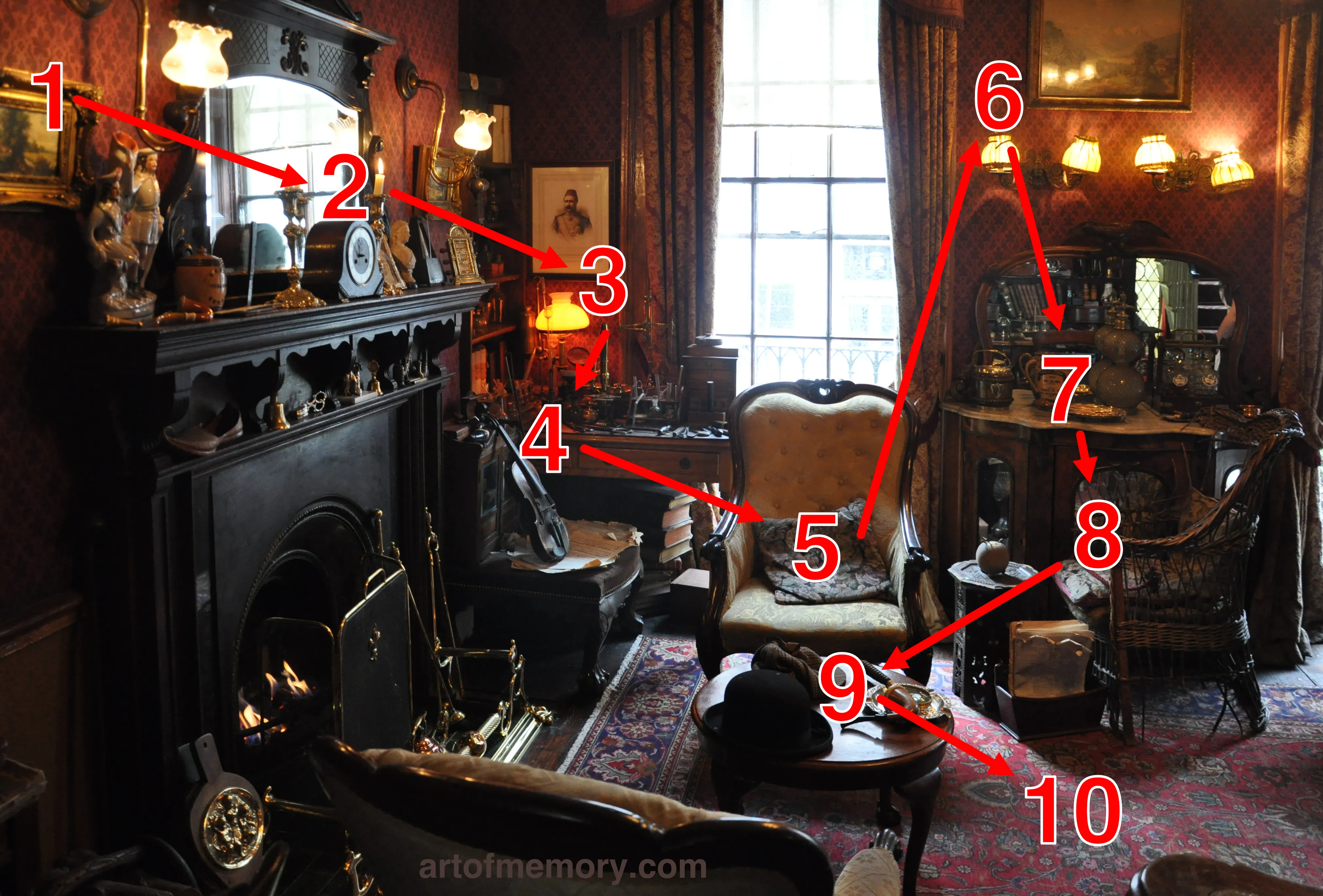
Here’s a list of the mind palace locations that are marked in the picture above:
- On the painting
- On the clock
- On the candle
- On the violin
- On the middle chair
- On the lamp
- On the dresser
- On the other chair
- On the small table
- On the rug
If you needed more locations, you could use every object in the room as a location. You could even turn every object in the room into a small mind palace of its own!
You should mentally walk through the picture until you can close your eyes and visit each location in the mind palace in order from memory.
2. Create Mnemonics for the Information You Want to Memorize
The second step in using a mind palace is to create an image for each fact you want to memorize.
To keep this introductory tutorial simple, we’ll use the mind palace to memorize a shopping list, because a shopping list consists only of simple objects that can be visualized.
Here’s the shopping list:
- bread
- potatoes
- carrots
- almonds
- onions
- pickles
- cabbage
- apples
- oranges
- lettuce
We now have 10 mind palace locations and 10 objects to place in the mind palace — one object per location.
We’ll combine the two lists (locations and shopping list) in the next step.
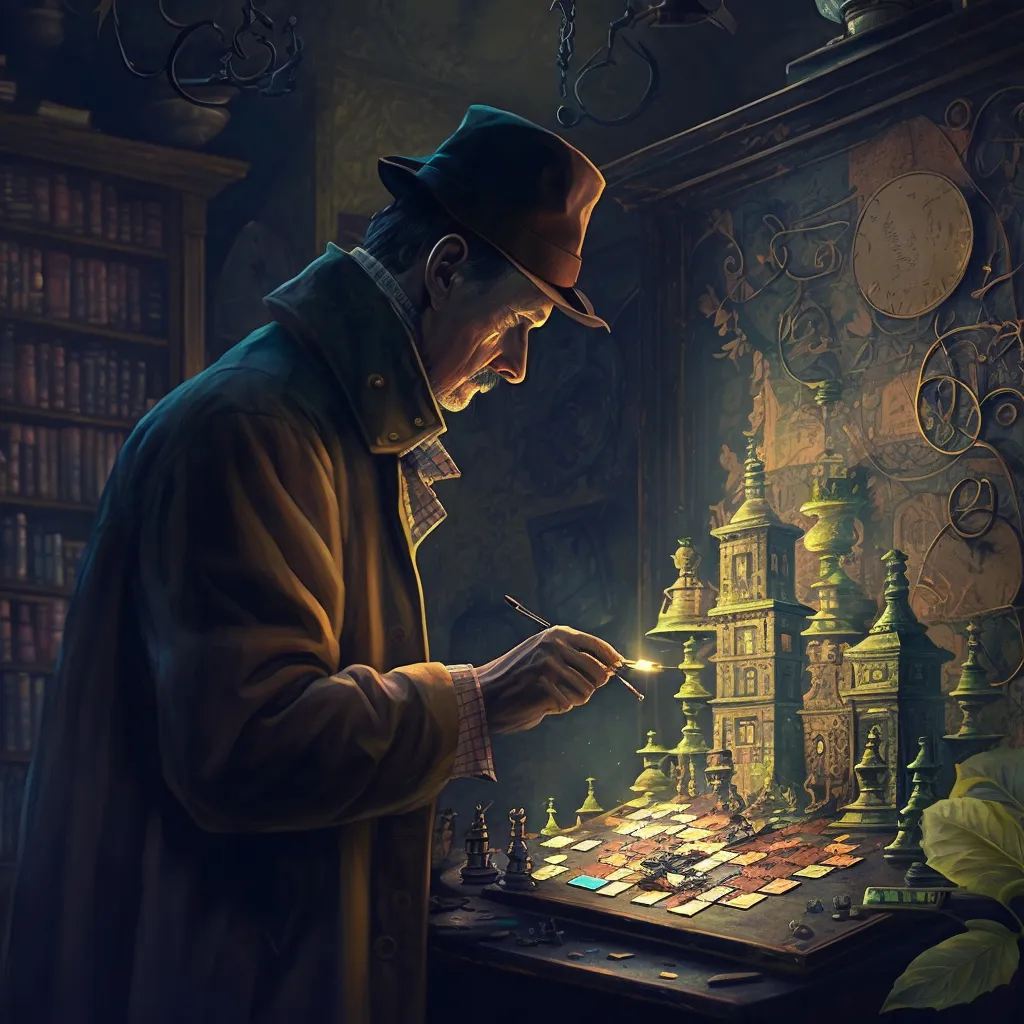
Tip: The images that are put into mind palaces are called mnemonic images.
In their simplest form, mnemonic images are mental pictures of the things you are memorizing. For example, all of the items in a shopping list are objects, and objects can be pictured easily. It’s easy to picture “carrots” or “bread”.
Mnemonic images can also represent abstract ideas. For example, it’s difficult to picture the word “free”, because “free” is an abstract concept.
In order to create a mnemonic image for that word, you would think of something that reminds you of “free”. You could picture getting free tickets to a concert, Tom Petty singing Free Fallin’, getting free samples of food at a grocery store, or any other picture that you can link back to the word “free”.
The image of “a free sample that you got at the grocery store” would be your mnemonic for the word “free”.
We won’t cover mnemonic images for abstract concepts in this tutorial, but if you want to learn more about that, see our How to Create Mnemonic Images tutorial.
3. Place the Information in the Mind Palace
Now we’re ready to place our mnemonic images of the shopping list into our mind palace locations.
Take an item from the shopping list and visualize it interacting with the corresponding location in the mind palace.
Example:
- The first location of the mind palace was “on the painting”.
- The first item in the shopping list is “bread”.
- Visualize bread interacting with the painting. You could picture rubbing a loaf of bread on the the painting so that pieces of the loaf start to become sanded off. Weird images tend to be memorable, so be creative.
After you place the first mnemonic image in the first location, move on to the second item and second location.
The second item was “potatoes”, and the second location was a clock. You could picture yourself throwing potatoes at the clock, trying to knock it off the mantle.
The third item was “carrots”. You could picture making a candle out of a carrot and using it for light in that location.
Continue through the list of 10 items and locations until all of them are placed. Here are both lists together:
| # | Location | Fact |
|---|---|---|
| 1 | On the painting | bread |
| 2 | On the clock | potatoes |
| 3 | On the candle | carrots |
| 4 | On the violin | almonds |
| 5 | On the middle chair | onions |
| 6 | On the lamp | pickles |
| 7 | On the dresser | cabbage |
| 8 | On the other chair | apples |
| 9 | On the small table | oranges |
| 10 | On the rug | lettuce |
Once you have all the items placed in your mind palace, mentally walk through the locations and see if you can remember everything. If you forgot an item, try to change the mnemonic image so that it’s stronger.
At this point, the shopping list is memorized in order. Don’t worry if you have to review it a few times. Mind palaces usually don’t eliminate the need to review the material occasionally, but they make retention vastly stronger — “impossible” memory feats become possible.
Tip: If you have questions about any part of the mind/memory palace technique, create a free account in our memory community and ask your questions there.
4. Recall the Information from the Mind Palace
Whenever you need to recall the information (in this case a shopping list), mentally walk through the locations of your mind palace and ask “what was happening at this location?”
The first location was a painting. You might remember that you were rubbing a loaf of bread on the painting, and pieces of the loaf were falling off. So that tells you that the first item in your list was a loaf of bread.
The second location was a clock. You were throwing potatoes at the clock, so the second item in your shopping list was potatoes.
Here’s the table of the locations, and the picture of the virtual mind palace, again — see if you can recall all 10 items:
| # | Location | Fact |
|---|---|---|
| 1 | On the painting | |
| 2 | On the clock | |
| 3 | On the candle | |
| 4 | On the violin | |
| 5 | On the middle chair | |
| 6 | On the lamp | |
| 7 | On the dresser | |
| 8 | On the other chair | |
| 9 | On the small table | |
| 10 | On the rug |
Learn More About Mind Palaces
For more-detailed instructions on how to create a mind palace like Sherlock, see How to Build a Memory Palace and Memory Palace Tips pages. Also take a look at the Roman Room technique.
The fastest way to learn how to use a mind palace is to join the Art of Memory Community — it’s free! You can ask questions and learn about powerful memory techniques from memory enthusiasts and champions.
