What Is a Mnemonic?
A mnemonic is a technique or device for remembering information. Mnemonics can be made up of words, mental pictures, body movements, physical objects, or just about anything that can help you remember information.
For example, a simple mnemonic to remember which side of your body is the left and which is the right involves extending your thumbs and looking at the back of your hands. The hand that looks like the letter “L” is the left side.
Here’s a picture:

Examples of Mnemonics
Mnemonics come in many forms. You might be familiar with some of the ones below.
Don’t forget to also check out our big list of memory techniques for studying that can help you get started on the path to advanced memory techniques.
Here’s a list of common mnemonics:
1. A Mnemonic for the Colors of the Rainbow
The colors of a rainbow are: Red, Orange, Yellow, Blue, Green, and Violet. If you take the first letter of each color you can spell the made-up name, “ROY G. BIV”.
If you can remember ROY G. BIV, then you can use the letters of the name as a mnemonic that translates back into the colors.

2. A Mnemonic for the Treble Clef
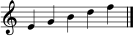
Another common mnemonic is Every Good Boy Does Fine, which represents the names of the notes that fall on the lines of a treble clef: E, G, B, D, and F.
3. The Memory Palace Technique
Not all mnemonics involve using letters. The memory palace technique is another kind of mnemonic that use spatial locations to keep information in order.
For example, if you wanted to remember a shopping list, you could imagine each item on your shopping list interacting with a location on your body.
Working from the top of your head to your feet, you could create 10-20 locations where you would imagine pictures of the things you want to remember. So if the first location is the top of your head, and the second location is your eyes, and the first two shopping items are carrots and milk, you could imagine carrots on the top of your head, tangled in your hair. You could imagine pouring milk on your eyes, and so on, placing each shopping list item at a different location on your body.
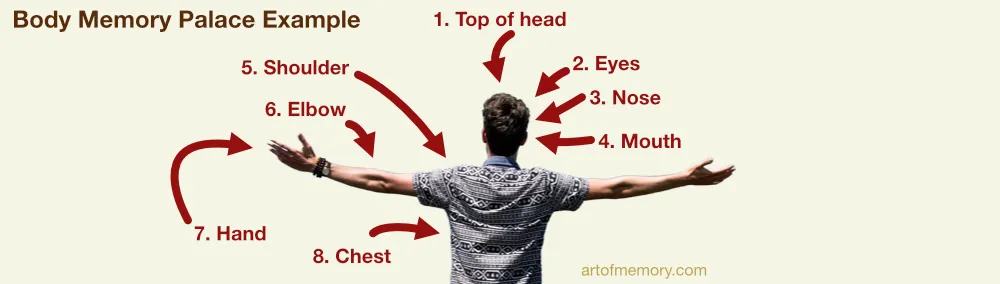
Then, to recall the items, you would mentally walk through the locations of your memory journey and see which item from your list is at that location.
If the first location is the top of your head, you would mentally look into that memory palace location and see what you were balancing there (carrots). Then you would move to the second location (eyes) and see what was happening there (pouring milk). The more memory palace locations you create, the more information you can store.
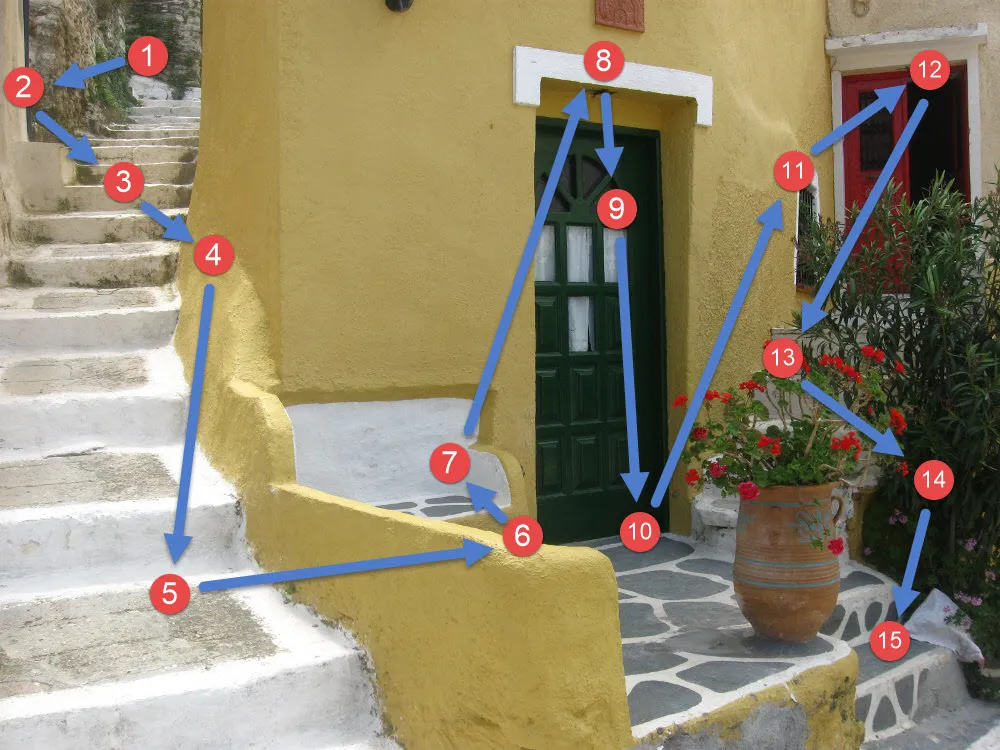
Memory palaces can be created in buildings and just about anywhere. The image below shows an example of creating locations for a memory palace in a small section of a Greek village.
To learn more about how to use them, see the memory palaces page.
4. Number Shapes
Another kind of mnemonic is the Number Shape System.
Each number can be turned into a mnemonic image of something that looks like the number.
For example, the number 1 looks like of like a candle. The number 2 looks kind of like a swan. The number 3 could be butterfly wings.
If you have to remember the address 31 Pine Street, you could imagine a butterfly (#3) flying around a candle (#1) on top of a pine tree (the name of the street) as your destination.
5. Word Mnemonics
You might be familiar with the famous mnemonic for an English spelling rule, “i before e, except after c”.
Another example of a word mnemonic is remembering the names of the Great Lakes (USA) with the phrase, “Super Heroes Must Eat Oats”. It stands for Superior, Huron, Michigan, Erie, and Ontario. You can read more about that technique on the acrostic mnemonics page.

6. Mnemonics for Symbols or Letters
It’s often easy to memorize symbols or letters by thinking of a familiar object that the letter or symbol looks like.
For example, you could remember that the Cyrillic letter “Ч” has a “ch” sound by imagining that the letter looks like an upside down chair stuck to the ceiling.
A basic principle of mnemonics is that it’s easier to remember new information if you can relate it to something that you already know. Most memory techniques involve developing systems to associate unknown data with things that are more easily memorized.
Learn More About Mnemonics
To learn more about mnemonics, download our free ebook, Learn the Art of Memory and join the free Art of Memory Forum.
Here are some articles related to mnemonics and human memory that you might find interesting:
