How to Memorize with the Dominic System
The Dominic System is a technique for memorizing long numbers by converting the digits into pairs of letters, and then associating those letters with easy to remember people and actions. It’s similar to the Major System but uses letters instead of sounds for creating mnemonic images.
For example, the number 1516 could be converted into a mental image of Albert Einstein (person) lifting weights (action), which is easier to remember than the number.
In the article below we’ll teach you the complete method for creating Dominic System images.
History of the Dominic System
The Dominic System was invented by Dominic O’Brien. It is a person-action (PA) system that encodes 4 digits at a time into compound images made up of a person and an action. It’s described in many of his books, including Quantum Memory Power.
How to Create a Dominic System
In the Dominic System, each 2-digit number from 00 to 99 gets assigned a person and an action. This will result in a system with 100 persons and 100 actions.
Step 1: Associate Persons with Numbers
The first step is to associate a person with each of the 100 numbers from 00 to 99. Go to our printable worksheets page and look for the PAO system worksheet. The Dominic System is a person-action system, but you can use the PAO worksheet as a guide, because you might want to add objects later.
You’re going to fill in each row of that worksheet with one person and one action. You can print the sheet, use a note-taking app to fill it out, or just use it as a guide to write up your system on paper.
First Pass: Associations
Dominic O’Brien has said that numbers can be assigned to images based on the first association that comes to mind. An example that he gives in his books is that the number 10 could be assigned to Dudley Moore because he was in a 1979 movie titled 10.
If you’re into sports, you could use the numbers of your favorite athletes. Magic Johnson’s number was 32, so you could use him as the person for number 32 in your Dominic System.
Make one pass through the whole list of 00 to 99 numbers in the worksheet and if you see any numbers that immediately remind you of a person, fill them in next to that number in the “person” column.
Second Pass: Letter Assignments
For the numbers that you can’t immediately associate with a person, you can use a system of letter assignments to convert numbers into people.
Several systems exist for converting digits into letters or sounds. For example, the Major System is similar to the Dominic System, but it uses sounds instead of letters.
The digit-letter associations used by Dominic O’Brien are:
| Number | Mnemonic |
|---|---|
| 1 | A |
| 2 | B |
| 3 | C |
| 4 | D |
| 5 | E |
| 6 | S |
| 7 | G |
| 8 | H |
| 9 | N |
| 0 | O |
Tip: To make it easier to remember the system, notice that the first five letters correspond to their position in the alphabet: A is the first letter, B is the second letter, etc. “S” is used for 6, because they both start with the letter “s”. “G” and “h” are the 7th and 8th letters of the alphabet. Nine starts with “n”, and 0 looks like the letter “o”.
Each digit becomes a letter, and the letter pairs then become the initials of someone’s name.
Here are some examples of converting numbers into people using the table above:
- The number 11 could be translated into the letters “AA” which could then become an image of Andre Agassi.
- The number 33 could be translated into the letters “CC” which could then become an image of Charlie Chaplin.
- The number 16 could be translated into the letters “AS” which could then become an image of Arnold Schwarzenegger.
On the worksheet or in your notes, fill in one person for each number from 00 to 99.
Step 2: Create the Actions
The next step is to go through the list of numbers and add an action for each person.
You can use any action that can be associated with that person.
For example, an action for Andre Agassi could be “playing tennis”. An action for Charlie Chaplin could be “swinging a cane”. An action for Arnold Schwarzenegger could be “lifting weights”.
At this point, the person and action columns of your worksheet will be filled in with a format something like this, though your specific images will be different:
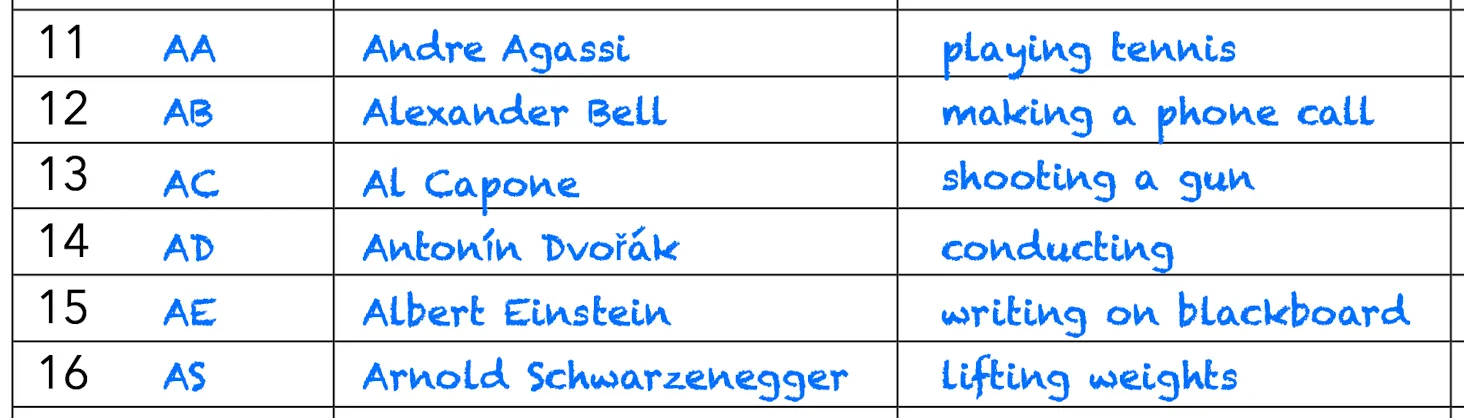
When you have a person and action for each 2-digit number from 00 to 99, your Dominic System is ready to use!
If you haven’t watched the following video yet, it might help you understand the next steps more easily:
Step 3: Practice Converting Numbers into Person-Action Images
With a 2-digit Dominic System, long numbers get chunked into groups of four digits. The first two digits are a person, and the second two digits are an action.
As an example, imagine that you have these mnemonic images in your Dominic System:
| Number | Initials | Person | Action |
|---|---|---|---|
| 11 | AA | Andre Agassi | playing tennis |
| 12 | AB | Alexander Bell | making a phone call |
| 13 | AC | Al Capone | shooting a gun |
| 14 | AD | Antonín Dvořák | conducting |
| 15 | AE | Albert Einstein | writing on a blackboard |
| 16 | AS | Arnold Schwarzenegger | lifting weights |
If you have a number chunk, 1316, you would split it into 13-16. You would then create a mental picture using the person for 13 (Al Capone) and the action for 16 (lifting weights). The resulting person-action image would be Al Capone lifting weights.
If the number chunk is 1613, then you would take the person from 16 (Arnold Schwarzenegger) and the action from 13 (shooting a gun). The resulting person-action image would be Arnold Schwarzenegger shooting a gun.
The person-action system gives you 10,000 unique images for all numbers between 0000 and 9999. It’s difficult for people to remember the difference between many numbers like 1316 and 1613, but it’s easy to tell the difference between a mental picture of Al Capone lifting weights and Arnold Schwarzenegger shooting a gun.
When you have a long number to remember it can be difficult to keep the images in order. The associated technique for keeping the images in order is called the memory palace technique (made famous by Sherlock’s mind palace and the book, Moonwalking with Einstein).
The PAO System
You can make the Dominic System even more powerful by expanding it to a PAO System (person-action-object), which is like a person-action system but it adds an object to each image.
Adding an object to each image allows you to store six digits in each location of your mind palace instead of just four. It also gives you 1 million unique mnemonic images instead of just 10,000. This extra efficiency can help improve your performance in memory competitions.
Memorizing Cards with the Dominic System
Your Dominic System images can also be used to memorize decks of playing cards.
Here’s a video of Dominic O’Brien demonstrating his system for card memorization:
Pre-made Lists
See the Dominic System Examples page for premade Dominic System lists.
Here are some lists of famous people:
Learning Your Images
Here are some scripts to help you practice your images. You don’t need to memorize the numbers and cards, but just practice converting them into images until you know your images well:
