How to Use Virtual Memory Palaces
A virtual memory palace is a memory palace that is based on artificial spaces, like art, software, computer games, books, or other sources.
If you’re having trouble finding enough memory palace locations in real-world spaces, virtual memory palaces can be used to find more.
Research suggests that imaginary memory palaces are just as effective as locations that one knows well in person. It’s possible that virtual spaces might not work as well for people with aphantasia though (more on that below).
Let’s look at a few ways to create virtual memory palaces.
Virtual Memory Palaces from Art
Check out this interesting comment:
I find a book of paintings (300-500 prints — the big art books are the best and color prints are better than black and white). Then I work through the paintings from the start, placing lines of poetry onto images within the paintings. I’ve been moving toward a standard 8 loci per painting. The trick is to come up with good associations between images within the paintings and the words of the poetry.
See also the page using paintings as memory palaces.
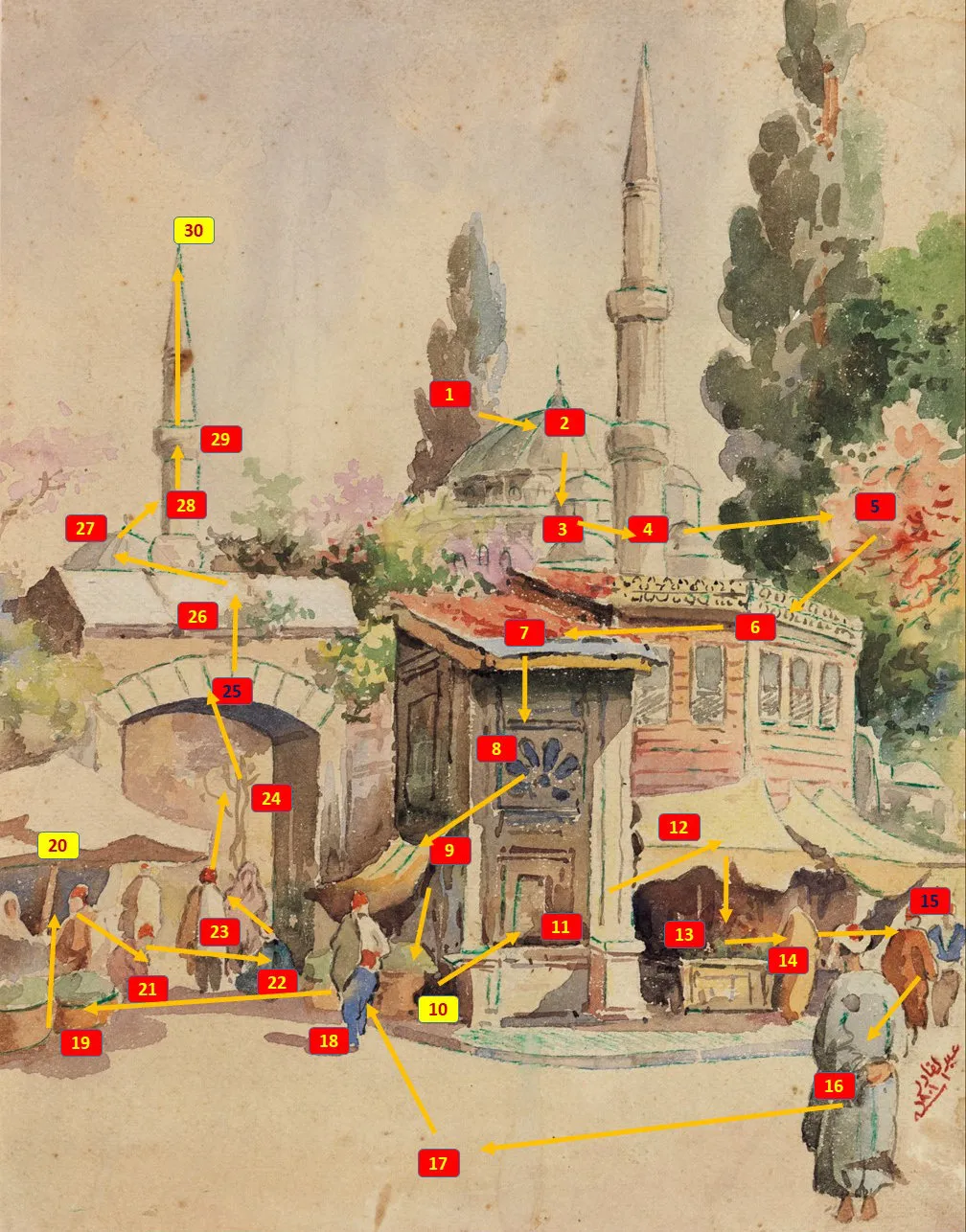
Here’s an example of how to create a virtual memory palace from a picture or painting:
- First, get a picture that looks like it can be divided into distinct locations.
- Mark each location with a number and draw lines between the locations in order.
- Practice mentally walking through the locations until you can do it from memory, without the picture in front of you.
- At that point, your virtual memory palace will be complete, and you can start using it to memorize things.
- See the example illustration below.
Here’s a memory palace that a forum member created from a painting:
Virtual Memory Palaces from Software
We offer memory palace software that is specifically created for managing your real and virtual memory palaces! See the link for more information.
Below are some other types of software that may be useful for finding virtual memory palace locations.
Memory Palaces from Virtual Tours
It’s possible to use online virtual tours as mind palaces. Here are some examples.
- 360 House Tours — This site lets you walk around in homes.
- Google Art Project — There are some interesting virtual tours here.
- Google Museums — Google Maps on Android can display virtual tours of museums.n
- Open House Virtual Tours — Virtual tours on YouTube.
- Tour de Force 360 VR — This site offers several 3D tours that can be viewed in the browser.
- Aynhoe Park Virtual Tour — A nice 17th century building interior.
- Jared Owen — YouTube videos of objects that could be used as memory palaces.
- 360 Cities — Many 3D photos and spaces to explore.
- Anne Frank — A virtual tour.
- Google Street View inside Businesses — You can search Google Maps for businesses that have interior 3D tours. There’s an example here.
Here’s an example of one of Google Maps’ indoor tours:
Here’s another virtual tour of a restaurant:
Virtual Memory Palaces from Design Software
If you want to create 3D virtual mind palaces with software, check out some of these options.
- Sketchup — This software isn’t free any more, but it might interest people.
- Houzz.com — Virtual house tours.
- Home Styler — Design virtual 3D houses.
- Home Design 3D — House-designing software.
- Open Simulator — Design 3D spaces. See also this memory palace discussion.
- Planner 5D — Design virtual reality houses that can be used as memory palaces.
Virtual Memory Palaces from Computer Games
Many people use video games to create their memory palaces. You can use just about any spatially-based 2D or 3D computer game — here are a few examples.
- Maya’s Memory Palaces — Mayarra has uploaded some videos about using games as virtual memory palaces.
- Various video game maps — There are some useful game map links here. Bioshock, Assassin’s Creed, Borderlands, Cyberpunk 2077, Death Stranding, Fallout, Far Cry, Zelda, and many other games are included.
- Minecraft can be used to create memory palaces. Here’s an example of Baldur’s Gate recreated in Minecraft.
- Game Tourism — This page has ideas on how to explore game landscapes.
- Bioshock Infinite Memory Palace — an example of a virtual memory palace using Bioshock.
- Baldur’s Gate Maps — classic game maps that could be used as virtual memory palaces.
- Other games that could work include Torment, Tyranny, and Pillars of Eternity.
Here’s an example memory palace of the Normandy SR-2 from Mass Effect 3:
Almost any 2D or 3D game with interesting landscapes could be used as a memory palace.
Virtual Memory Palaces from Books
You can create memory palaces from locations based on books. You could use the scenes in the book as peg-like locations, and/or maps of the landscapes or buildings found in the book.
Examples of books with good maps are The Hobbit and the Lord of the Ring trilogy by J.R.R. Tolkien.
Virtual Memory Palaces from Webcomics
Webcomics make decent memory palaces because they are sequential scenes.
An example of a webcomic is Homestruck.
Virtual Memory Palaces from Manga
Like webcomics, above, Manga can also be used for virtual memory palace locations.
Virtual Memory Palaces from Movies
Check out this guide to using TV and movie scenes as memory palaces.
GoPro movies can be used as memory palaces. Here’s an example of a YouTube movie/video that could provide memory palace locations:
Another good resource is Animation Screencaps.
See also these discussions in the forum:
Virtual Memory Palaces from TV Shows
Like movies, TV shows can also be used for memory palaces.
There’s a site that has floor plans from popular TV shows
For a related TV show that you could use, check out Sherlock’s Mind Palace.
Virtual Memory Palaces and Aphantasia
Lynne Kelly brought up an interesting point in the forum about aphantasia:
My concern for the imaginary palace would be for students with aphantasia - no visual imagery. It is why I always use physical palaces. That would be very few of your students, but you will have them. I would suggest checking with students how well they can remember imaginary palaces, and even let them decide which would be better - although a palace for the whole class would work best because of the group encoding.
Additional Resources
- Getting more memory palace locations from Google Maps
- Video game memory palaces
- Best computer games for virtual memory palaces
Memory Palace Guide
Learn more about how to use memory palaces.
- How to Build a Memory Palace 🔥
- Learn How to Use Sherlock's Mind Palace 🔥
- How to Create Virtual Memory Palaces 🔥
- Books About Memory Palaces
- How to Reuse Memory Palaces
- List of Memory Techniques for Studying
- How to Use Spaced Repetition
- How to Use the Method of Loci
- Advanced Memory Palace Tips
- Memorize Numbers with a Memory Palace
- Memory Palace for Language Learning
- Simonides of Ceos and the Method of Loci
