Memorizing Poetry (Shakespeare) Using the Method of Loci
I’ve been experimenting with methods for memorizing poetry. Here are examples of the mnemonic images I used to memorize Hamlet’s famous soliloquy.
The Method of Loci
The method of loci is a mnemonic technique that goes back at least 2,500 years to the ancient Greeks. If you aren’t familiar with the method of loci yet, this post might not make a lot of sense. I recommend reading one of the memory books on my reading list or asking questions about it in the memory forum. A great book to start with is Dominic O’Brien’s How to Develop a Brilliant Memory Week by Week.
To quickly summarize the method: a mental journey is created, and the data to be memorized is converted into bizarre, exaggerated, visual images that are then placed along the imaginary journey, fooling the mind into believing that it has traveled along the journey. To recall the information, one mentally walks back through the journey, converting the visual images back into the original information that was memorized.
If you’ve never tried the method of loci, it may sound strange, but it’s the same basic concept that people use to memorize thousands of random digits. The key is to convert everything to visual images. Visual memory is incredibly powerful.
The Text to Be Memorized (from Hamlet)
Here is the text to be memorized as written in the book, By Heart: 101 Poems to Remember:
To be, or not to be: that is the question: Whether ‘tis nobler in the mind to suffer The slings and arrows of outrageous fortune, Or to take arms against a sea of troubles, And by opposing end them? To die: to sleep; No more; and, by a sleep to say we end The heart-ache and the thousand natural shocks That flesh is heir to, ‘tis a consummation Devoutly to be wish’d. To die, to sleep; To sleep: perchance to dream: ay, there’s the rub; For in that sleep of death what dreams may come When we have shuffled off this mortal coil, Must give us pause: there’s the respect That makes calamity of so long life; For who would bear the whips and scorns of time, The oppressor’s wrong, the proud man’s contumely, The pangs of dispriz’d love, the law’s delay, The insolence of office and the spurns The patient merit of the unworthy takes, When he himself might his quietus make With a bare bodkin? who would fardels bear, To grunt and sweat under a weary life, But that the dread of something after death, The undiscover’d country from whose bourn No traveller returns, puzzles the will And makes us rather bear those ills we have Than fly to others that we know not of? Thus conscience does make cowards of us all; And thus the native hue of resolution Is sicklied o’er with the pale cast of thought, And enterprises of great pith and moment With this regard their currents turn awry, And lose the name of action.
It’s blank verse (unrhymed iambic pentameter) which helped me figure out the correct word at points. Here is an example of iambic pentameter—five beats of da-DUM rhythm:
For IN that SLEEP of DEATH what DREAMS may COME
During recall, if you notice that the words don’t fit iambic pentameter, it may be that you are recalling the wrong word. Not every line follows strict iambic pentameter, so it helps to pay attention to the meter when memorizing.
The Memory Journey
I was memorizing the second half of the text as I was waiting for the subway in the Berkeley, California BART station, so I made up a journey on the spot, starting at the main entrance and going down into the station.
The Mnemonic Images
Here are the images I placed in the BART station:
Locus 1: Station Entrance
TEXT: For who would bear the whips and scorns of time,
IMAGES: A giant, angry grizzly bear is blocking the entrance to the station, while an hourglass (time) is whipping some acorns (scorns).
Locus 2: Escalator Down
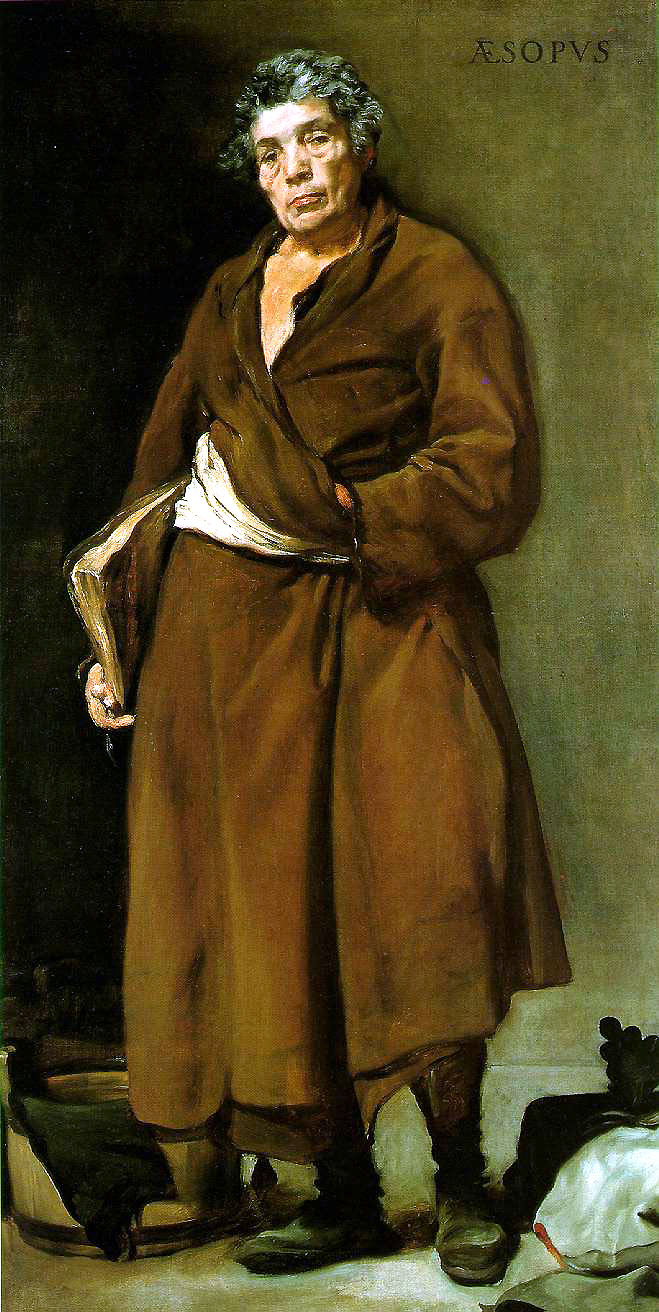
TEXT: The oppressor’s wrong, the proud man’s contumely,
IMAGES: In my phonetic number system, the sound “op” is the same as the image for 09 (Aesop), but encased in a block of ice (an image modifier that reverses the way 09 is read, from “suh” to “op”). Aesop is encased in a block of ice and pressing a button: op-press (oppressor). Someone name Ron (wrong) is in front of the block of ice. In front of them is a man with his held held in an arrogant way wearing a nobleman’s costume (proud man). I don’t have a specific costume in mind, but just a vague impression of fluffy, colorful sleeves and chin held high. Contumely is a strange word and was easy for me to remember without an image.
[EDIT: For a longer description of how my mnemonic system for sounds works, see this post.]
Locus 3: In Front of Peet’s Coffee Stand
TEXT: The pangs of dispriz’d love, the law’s delay,
IMAGES: A heart (love) with sharp fangs (pangs) is holding a carnival prize (dispriz’d) and standing to the left of Judge Dredd (“I am the Law”) who is holding an hourglass (delay).
Locus 4: The Ticket Gates
TEXT: The insolence of office and the spurns
IMAGES: In my phonetic system, the sound, “in,” is the image for the number 62 encased in a block of ice – in this case Obi Wan Kenobi. The block of ice is held up by a soldier – the image for 005, pronounced “SOL.” In-sol is enough to trigger the memory of insolence. I placed some cubicles (office) around the in-sol image. On the other side of the ticket gates is a cowboy with giant spurs (spurns).
Locus 5: In Front of the Agent Booth
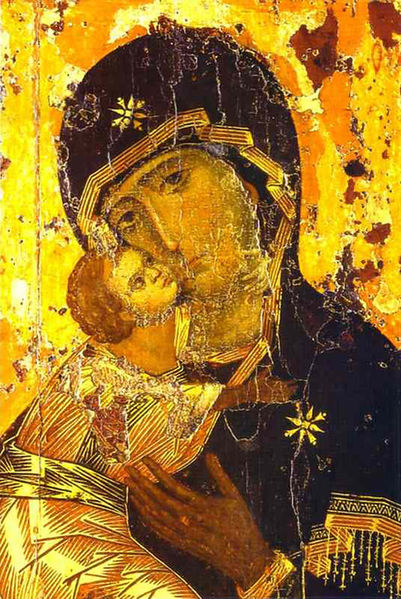
TEXT: The patient merit of the unworthy takes,
IMAGES: A patient on a stretcher is next to a Byzantine icon of Mary on the back of a mare (merit). The two “mer” images reinforce the sound and prevent me from decoding the image of the mare as a synonym like “horse.” Next to the mare and icon, Wayne and Garth are saying “We’re not worthy!” (unworthy).
Locus 6: In Front of the Stairs Down to the Tracks
TEXT: When he himself might his quietus make
IMAGES: The mighty (might) He-Man (he) is looking at himself in a mirror (himself). Quietus is another intriguing word that stuck in my head without the need for an image.
Locus 7: Bottom of Stairs
TEXT: With a bare bodkin? who would fardels bear,
IMAGES: A woman’s bare body (bare bod-kin). She is holding an arm behind her back, concealing a bare bodkin (dagger). The rest of this line didn’t need an image because of the strange sentence structure that caused me to read it quite a few times and look up the definition of the word fardels. Translation into modern English: “who would bear burdens.”
Locus 8: Stepping onto the Train
TEXT: To grunt and sweat under a weary life,
IMAGES: A pig is grunting and sweating under a strange compound image of a giant lifesaver candy (life) that, together with a werewolf, is wearing a single coat. Wearing and werewolf together reinforce the word weary.
Locus 9: Down the Aisle of the Train
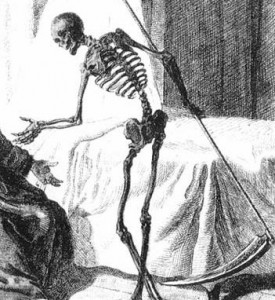
TEXT: But that the dread of something after death,
IMAGES: A goat is butting (but that) Judge Dredd (the dread) who bumps into the Grim Reaper (death)–they are both looking behind death (after death). The thing they are looking at is in the next locus.
The method of encoding the images involves reading the words in the text with alternate meanings. The line, “But that the dread of something after death,” is read something like, “[the goat] Butt that: the [Judge] Dredd [bumps into Death himself as they peer at] something after [physically behind] Death.” It involves hacking the grammar interpretation a bit.
Reading two or more unrelated parallel meanings into a line of text at the same time makes neurons go crazy. (In a good way.) After time, the mnemonic images fade from the front of consciousness, and it’s possible to focus completely on the real meaning of the text.
Locus 10: In a Seat in the Right Side of the Train
TEXT: The undiscover’d country from whose bourn / No traveller returns,
IMAGES: Death (see previous locus) is peering into the seat area and sees a paper with a new undiscover’d country mapped on it. Hiding under the seat is Matt Damon as Jason Bourne (bourn).
Locus 11: Rear Door of Train Car, Right Side
TEXT: … puzzles the will
IMAGES: This image appears as a three-dimensional jigsaw puzzle. The last pieces of the puzzle are completing an image of someone named Will. The word “puzzles” becomes a verb meaning to convert into a jigsaw puzzle (puzzles the will).
Phrases like,“The Dredd,” and “The Will,” referring to persons, sound weird in English, but many languages use a definite article like “the” before personal names, so the phrasing is memorable to me if I stretch the interpretation a little.
Locus 12: Seat at the Back Left of the Train Car
TEXT: And makes us rather bear those ills we have
IMAGES: This is a weird one. First, Will is transforming “us” into Dan Rather (makes us rather). Bear becomes a noun-transformed-into-a-new-verb: a grizzly bear is “bearing” (clawing) those ills. In my mnemonic system, the sound ill is represented by the image for number 65 (pot of boiling water) encased in a block of ice. So, the bear is clawing a giant block of ice that contains a chamber with several pots of boiling water (bear those ills). On the other side of the ice block, we are halving a bagel (we have). Whew…
Locus 13: Through a Window of the Train
TEXT: Than fly to others that we know not of?
IMAGES: The previously-mentioned bagel halves go flying through the window in an explosion of shattered glass towards Ben Linus, the leader of “The Others”, from the TV show Lost (fly to others).
Locus 14: Back on the Platform outside the Window
TEXT: Thus conscience does make cowards of us all;
IMAGES: The image for the sound “con” is the same as for the number 742—Khan from the Star Trek movie The Wrath of Khan (con-science). Khan is directing some crazy female deer (does) who are wildly prancing around on their hind legs, holding magic wands with their forelegs, turning all of “us” into cows (make cow-ards of us all).
Locus 15: Still on the Platform
TEXT: And thus the native hue of **resolution / Is sicklied o’er** with **the pale cast of thought,**
IMAGES: A hunter-gatherer (the native) with a stone ax hews (hue) an old Apple 2gs computer with dithered resolution. The dithered image on the screen is a sickly-looking, anthropomorphized oar (sicklied o’er). Above the computer is a face, looking down, beaming a pale light on the computer (the pale cast of thought). The forehead has a fishing rod sticking out of it, fishing for the hacked up pieces of the computer (reinforcing the word, cast).
Put together in a weird new sentence with a hacked parallel meaning it reads something like: “the native’s hew of [the computer’s] resolution …”
and:
“[the computer’s] resolution is [a] sicklied oar …”
I remembered the pattern of “thus” by comparing two lines:
Thus conscience does make cowards of us all; And thus the native hue of resolution
Locus 16: Still on the Platform
TEXT: And enterprises of great pith and moment
IMAGES: Just beyond the previous scene are a couple of Star Trek Enterprises made out of the pith of giant mullein stalks.
Locus 17: Still on the Platform
TEXT: With this regard their currents turn awry, / And lose the name of action.
IMAGES: Exiting from one of the Enterprise ships, on a ramp similar to the one on the Millennium Falcon, is a Buckingham Palace guard—the changing of the guard becomes re-guard (regard). Also flowing out of the exit ramp is a current of currants (image reinforcement) which are turning into loaves of rye bread: “their currants turn a-rye” (currents turn awry).
I was getting confused about how the line starts. Was it “In this regard?” (No.) I turned “With this” into width-hiss—a ridiculously fat snake poking its head out of the spaceship, and the problem was solved.
I didn’t need an image to remember the last line.
It Works!
This is just an early attempt at using the method of loci for memorizing poetry, but it seemed to be very effective. Between reading the lines several times and key images placed along the memory journey, I was able to quickly memorize the verse.
One other interesting outcome is that, now, every time I pass through the Berkeley BART station, the location triggers a word-for-word memory of some of Shakespeare’s most famous lines.
If anyone has any suggestions on poetry memorization technique, or questions about what I’ve written above, please leave a comment below.


