Ten and Under Challenge
Ten Commandments
Exodus 20:2-17 (King James Version). See also differences in the 10 Commandments between different religions.
Seven Wonders of the Ancient World
- Great Pyramid of Giza
- Hanging Gardens of Babylon
- Statue of Zeus at Olympia
- Temple of Artemis at Ephesus
- Mausoleum of Halicarnassus
- Colossus of Rhodes
- Lighthouse of Alexandria
Seven Heavenly Virtues
The seven heavenly virtues originated in the Psychomachia (“Contest of the Soul”), an epic poem written by Aurelius Clemens Prudentius (c. AD 410) entailing the battle of good virtues and evil vices. Each virtue was created with a corresponding vice which is given in brackets in the list below.
- Chastity (Lust)
- Temperance (Gluttony)
- Charity (Greed)
- Diligence (Sloth)
- Patience (Wrath)
- Kindness (Envy)
- Humility (Pride)
Seven Deadly Sins
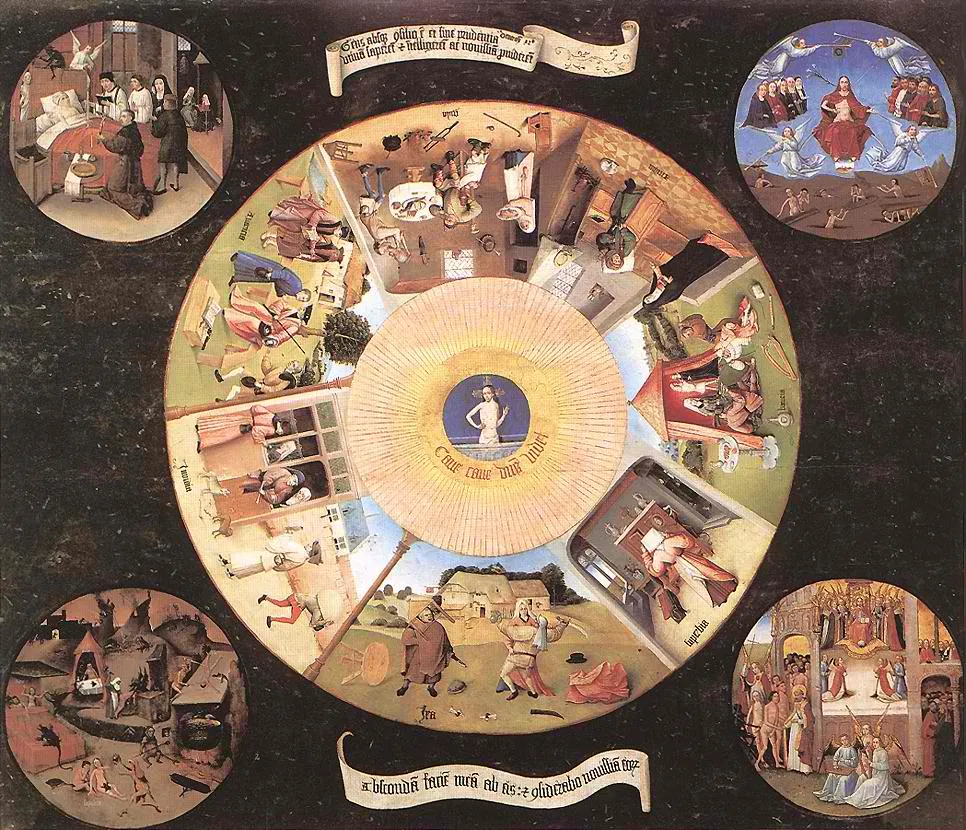
In AD 590, a little over two centuries after Evagrius wrote his list, Pope Gregory I revised this list to form the more common Seven Deadly Sins, by folding sorrow/despair into acedia, vainglory into pride, and adding envy. In the order used by both Pope Gregory and by Dante Alighieri in his epic poem The Divine Comedy, the seven deadly sins are as follows:
- luxuria (lechery/lust)
- gula (gluttony)
- avaritia (avarice/greed)
- acedia (acedia/discouragement)
- ira (wrath)
- invidia (envy)
- superbia (pride)
Acedia is now more often given as “sloth,” so the list below (in the order given on the wheel diagram by Bosch) is:
- wrath
- envy
- greed
- gluttony
- sloth
- lust
- pride
Seven Dwarfs
- Doc
- Grumpy
- Happy
- Sleepy
- Bashful
- Sneezy
- Dopey
One mnemonic is “2 S’s, 2 D’s, and 3 emotions”: Sleepy, Sneezy, Doc, Dopey, Happy, Grumpy, Bashful.
Another is the sentence, “Do Green Snails Have Slippery Backs, Doc?”: Dopey, Grumpy, Sneezy, Happy, Sleepy, Bashful, Doc.
Six wives of Henry VIII and their fates
- Catherine of Aragon (annulled)
- Anne Boleyn (annulled then beheaded)
- Jane Seymour (died of childbed fever)
- Anne of Cleves (annulled)
- Catherine Howard (annulled then beheaded)
- Catherine Parr (survived)
The traditional mnemonic for their fates is “divorced, beheaded, died, divorced, beheaded, survived.”
The names can be remembered with the acronym CAJACC, where the Catherines (CA, CH, CP) and Annes (AB, AC) are in alphabetical order.
Kubler-Ross’s Five Stages of Grief
- Denial
- Anger
- Bargaining
- Depression
- Acceptance
Five longest rivers
- Nile, Africa (6,825 km)
- Amazon, South America (6,437 km)
- Chang Jiang (Yangtze), Asia (6,380 km)
- Mississippi, North America (5,971 km)
- Yenisey-Angara, Asia (5,536 km)
Mnemonic:
Nile Amazon Chang Jiang,
Miss-is-sippi Yeni-sey Ang.
Ref: Google Book
Five tallest mountains
- Mount Everest 8850m (29035ft) Nepal/China
- Qogir (K2) 8611m (28250ft) Pakistan
- Kangchenjunga 8586m (28169ft) Nepal
- Lhotse 8501m (27920ft) Nepal
- Makalu I 8462m (27765ft) Nepal
Five most populated countries as of 2011
| Rank | Country | Population | Percent of World Population |
|---|---|---|---|
| 1 | China | 1,342,120,000 | 19.5% |
| 2 | India | 1,193,590,000 | 17.3% |
| 3 | US | 311,999,000 | 4.5% |
| 4 | Indonesia | 237,556,363 | 3.4% |
| 5 | Brazil | 190,732,694 | 2.8% |
Asimov’s Three Laws of Robotics
- A robot may not injure a human being or, through inaction, allow a human being to come to harm.
- A robot must obey any orders given to it by human beings, except where such orders would conflict with the First Law.
- A robot must protect its own existence as long as such protection does not conflict with the First or Second Law.
United States Bill of Rights
First Amendment – Establishment Clause, Free Exercise Clause; freedom of speech, of the press, and of assembly; right to petition
Congress shall make no law respecting an establishment of religion, or prohibiting the free exercise thereof; or abridging the freedom of speech, or of the press; or the right of the people peaceably to assemble, and to petition the Government for a redress of grievances.
Second Amendment – Militia (United States), Sovereign state, Right to keep and bear arms.
A well regulated Militia, being necessary to the security of a free State, the right of the people to keep and bear Arms, shall not be infringed.
Third Amendment – Protection from quartering of troops.
No Soldier shall, in time of peace be quartered in any house, without the consent of the Owner, nor in time of war, but in a manner to be prescribed by law.
Fourth Amendment – Protection from unreasonable search and seizure.
The right of the people to be secure in their persons, houses, papers, and effects, against unreasonable searches and seizures, shall not be violated, and no Warrants shall issue, but upon probable cause, supported by Oath or affirmation, and particularly describing the place to be searched, and the persons or things to be seized.
Fifth Amendment – due process, double jeopardy, self-incrimination, eminent domain.
No person shall be held to answer for a capital, or otherwise infamous crime, unless on a presentment or indictment of a Grand Jury, except in cases arising in the land or naval forces, or in the Militia, when in actual service in time of War or public danger; nor shall any person be subject for the same offence to be twice put in jeopardy of life or limb; nor shall be compelled in any criminal case to be a witness against himself, nor be deprived of life, liberty, or property, without due process of law; nor shall private property be taken for public use, without just compensation.
Sixth Amendment – Trial by jury and rights of the accused; Confrontation Clause, speedy trial, public trial, right to counsel
In all criminal prosecutions, the accused shall enjoy the right to a speedy and public trial, by an impartial jury of the State and district wherein the crime shall have been committed, which district shall have been previously ascertained by law, and to be informed of the nature and cause of the accusation; to be confronted with the witnesses against him; to have compulsory process for obtaining witnesses in his favor, and to have the Assistance of Counsel for his defence.
Seventh Amendment – Civil trial by jury.
In suits at common law, where the value in controversy shall exceed twenty dollars, the right of trial by jury shall be preserved, and no fact tried by a jury, shall be otherwise re-examined in any court of the United States, than according to the rules of the common law.
Eighth Amendment – Prohibition of excessive bail and cruel and unusual punishment.
Excessive bail shall not be required, nor excessive fines imposed, nor cruel and unusual punishments inflicted.
Ninth Amendment – Protection of rights not specifically enumerated in the Constitution.
The enumeration in the Constitution, of certain rights, shall not be construed to deny or disparage others retained by the people.
Tenth Amendment – Powers of States and people.
The powers not delegated to the United States by the Constitution, nor prohibited by it to the States, are reserved to the States respectively, or to the people.
