How to Memorize a Book or Textbook
The easiest way to memorize a book or textbook is to use a memory palace or peg list. In this article, we’ll discuss the different types of book memorization and the relevant memory techniques.
Here are the steps to memorize a book:
1. Decide What Facts You Need to Remember from the Book
Before you start to memorize a book, you should decide whether your goal is to memorize only the important facts from it or try to memorize it verbatim, which means memorize every word in the book.
Here are five kinds of ways to memorize a book, from easiest to hardest:
- Memorize just the title and author.
- Memorize title, author and the table of contents/main plot points.
- Memorize a couple main ideas and/or quotes from each chapter.
- Memorize the main idea of each paragraph, along with some complete passages.
- Memorize the book verbatim, that is, every single word.
Examples:
- If you want to remember the names of all of Shakespeare’s plays, or a list of the Harvard Classics, you would only memorize the titles and authors of the books.
- If you want to remember a few of the most important points from each book you read, you could memorize the table of contents or the main plot points.
- If you want to memorize ideas from a school textbook before an exam, you would probably memorize the main ideas from each chapter or section of the textbook.
- If you want to memorize a long poem, like Dante’s Inferno, you might want to memorize it word-for-word.
Memorizing word-for-word (verbatim), is very difficult and time consuming, so on this page we’ll focus more on memorizing the important parts of books, not every word.
We also have a separate page with resources for Bible memorization.

2. Choose a Memory Technique
In most cases, the main mnemonic techniques for memorizing books are memory palaces and peg lists.
Both techniques are good for memorizing lists of facts in order. If you can extract the points that you want to memorize from a book or textbook, you can memorize them with either a memory palace or a peg list.
There are other memory techniques that may be useful as well. For example, if the facts that you’re memorizing include dates or other numbers, you’ll also want to have a system for memorizing numbers. Having a few alphabet peg lists ready can also be useful.
If you’re a beginner with memory techniques, a good place to learn them quickly is to read our short free PDF ebook.
It can take some practice to become comfortable using memory techniques, so don’t wait until the last minute. If you have a short deadline, you might want to save the memory techniques for later, after you finish your homework for your tight deadline.
3. Extracting Facts from the Book or Textbook
As you read through the book or textbook, write down the facts that you want to remember and put them in your notes.
Memory palaces and peg lists are especially suited for memorizing lists of things, so try to extract the data out of the book as a list of facts. There might be a keyword that you could associate with a fact or a section. That keyword could be turned into a mnemonic image that could be placed in a location of a memory palace or attached to a peg in your peg list.
It’s good to be familiar with the story method, and mnemonic linking so you can link a few ideas into one location or peg.
You may want to use the table of contents as a guide on how to structure your mind palace (see below).
After you have your notes in a format that is friendly for memory palaces and peg lists, you can start memorizing.
4. Practice Recalling Facts from the Book
Recalling information from your memory palace or peg list uses active recall, which helps make your memories stronger.
It’s highly recommended to use the Feynman technique while studying, because it will help you be sure that you understand what you’re studying. It’s one of the most powerful study techniques available.
You can used spaced-repetition software to remind you when to review the information. Walk through each step of your memory palace or peg list and recall the facts that are stored there. It’s okay and normal to review your memory palace multiple times. There is no magic pill for studying that will instantly make you able to remember everything effortless. You still need to work hard, but memory palaces will let you store more information than would normally be possible with rote memorization.

How to Memorize a Textbook
If you’re memorizing a textbook, you may want to try an approach like this:
- First, look through the table of contents to see the structure of the book.
- Then browse or skim through a chapter or two to see how the textbook is organized. Usually, there are headers or boxes followed by an explanation.
- Count the number of larger sections (chapters), medium sections (chapter headers), and smaller sections.
- Once you understand the structure of the textbook, you can begin to design a memory palace to hold that information. Check out the how to learn memory techniques page for more information about the basic techniques.
- Memory palaces work well with lists of things, so try to break the content down into lists.
- If you want to group information within one of the structured groups (marked in red, blue, and green in the image of the textbook below), you can group them by location.
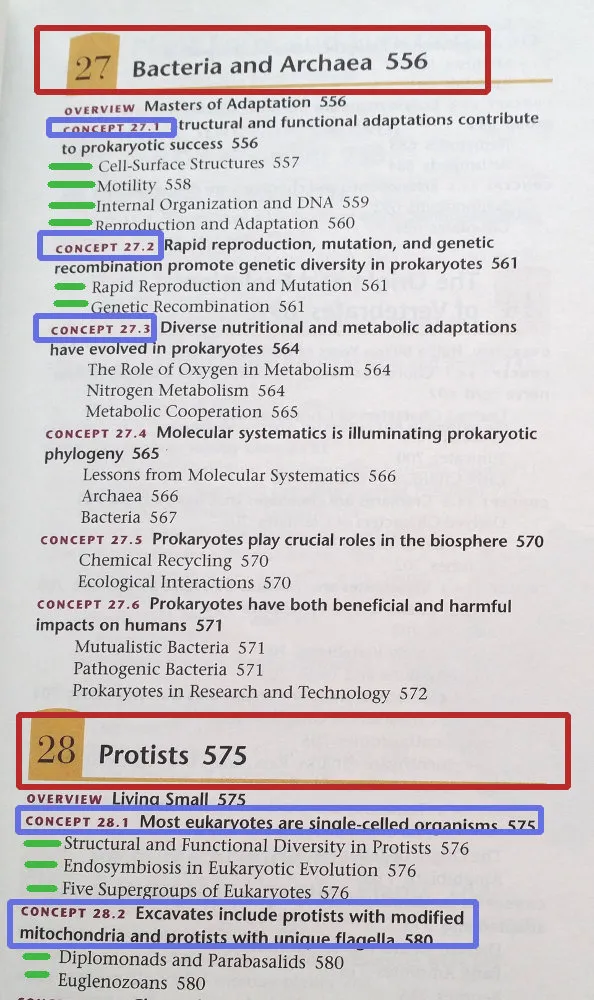
Example
Using the example image of a biology textbook’s table of contents, chapter 27 might go in its own memory palace: “Bacteria and Archaea”. Within that palace would be seven rooms, one for the overview section, and six for the “concept” sections. Within each room, you would place mnemonic images that represent things that you’re learning in that section.
So in the room for Concept 27.1, you might have a few locations for “Cell-Surface Structures” and a few more for “Motility”. If a textbook section requires more than a few locations, you could expand it into its own room.
Further Reading about Book Memorization
- How do I memorize a book?
- How do I memorize a dictionary?
- How to memorize a history textbook
- Best method to memorize a textbook?
- “How I memorized an entire chapter from Moby Dick”
- How to memorize non-fiction books
- How to memorize textbooks or heavily information dense material. See also this update and here.
- Help dealing with repeated images memorizing a dictionary.
- Memorizing key ideas of a book
