Giordano Bruno's Memory Systems
Giordano Bruno was a 16th century philosopher and mnemonist who had some interesting memory techniques. This page contains links to many pages that discuss his techniques.
Discussions About Giordano Bruno
There are many discussions on this site about Giordano Bruno’s memory systems. Here are a few:
- Where to start with Giordano Bruno and Raymond Llull work
- Can someone identify this wheel, and resources on how to use it?
- Bruno and Verbatim Memorization of Law
- On the Shadows of Ideas by Giordano Bruno
- Question Regarding Giordano Bruno’s PAO
- Giordano Bruno’s Clavis Magna
- Giordano Bruno’s books on magical memory
- Bruno Giordano’s method
- Ars Combinatoria, Bruno, Llull
- Giordano Bruno’s Art of Memory
- Free book on Giordano Bruno online
- Historically Method of Loci Banned? Giordano Bruno Experts?
- Giordano Bruno Articles
- Giordano Bruno: De Umbris Idearum (‘The Shadow of Ideas’)
- Do You Guys Know Anything About Bruno’s Memory Seals?
- Bruno’s “Incantations of Circe”
- Question about a possible Bruno reference
- Verbatim Memorization / Bruno
- Decoding Bruno’s Thirty Seals
- Giordano Bruno’s Memory Wheel
- Giordano Bruno’s De monade numero et figura (On the Monad, Number and Figure)
- Greek mythology – How I am organizing the info
- Nested Memory Palace
- John Florio, Renaissance England, and Art of Memory
- Understanding and using Fludd’s Round Art
- Consulta Método Girodano Bruno (in Spanish)
Here is a fascinating webpage about Giordano Bruno’s memory system.
Frances Yates reconstructed Bruno’s mnemonic wheel based on his book De Umbris Idearum. De Umbris Idearum can be downloaded here. Unfortunately, I’ve only seen it available in Latin so haven’t been able to read it.
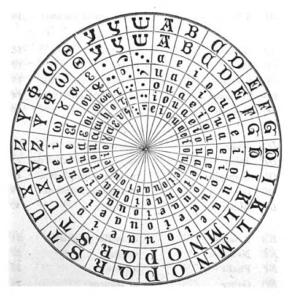
Bruno’s system has a few similarities with the Dominic System and the person-action-object (PAO) system, where different images can be combined to expand the image vocabulary:
In the first fixed ring the practitioner will assign a mythological or heroic figure to each letter. Bruno provides some examples : A Lycaon; B Deucalion; C Apollo; D Argos … (see De Umbris Idearum [PDF], pp. 107 ff). The letters of the second ring correspond to an action or a scene associated with each figure. The examples provided are: AA Lycaon at a banquet; BB Deucalion and pebbles; CC Apollo and Python; DD Argos and some cattle (ibid, p. 112). Thus rotating the first inner ring operates permutations between the figures and their action. Further permutation occurs when the third wheel is set in motion. It contains attributes or enseignes which can be easily passed from one figure to another. Bruno provides only four examples and leaves the rest to the imagination of his reader. These are : AAA, Lycaon at a banquet with a chain; BBB, Deucalion and pebbles with a headband; CCC, Apollo and Python with a baldric; DDD, Argos and some cattle with a hood. This way the systems makes it possible to create combinations of letters representing words, acronyms or syllables to be remembered by means of animated images mixing the attributes and accustomed actions of familiar mythological figures.
BAA: B Deucalion A at a banquet A with a chain MAD: M Perseus A at a banquet D with a hood CAD: C Apollo A at a banquet D with a hood COD: C Apollo O and Proserpina D with a hood
“Deucalion at a banquet with a chain. Perseus at a banquet with a hood.” It isn’t exactly a PAO system, but it has a familiar sound. I hope I can eventually find a copy of De Umbris Idearum in English so I can read the entire description of Giordano Bruno’s technique.
Yates’ full memory wheel reconstruction can be viewed here [PDF]. Some of Bruno’s great imagery is described here. An excerpt is below:
The Seven Images of Mars
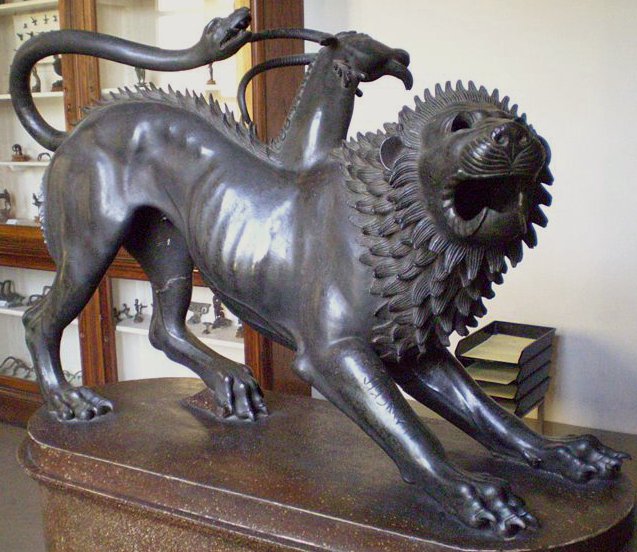
The First Image of Mars is a Man armoured and riding upon a Lion upon whose Helm a Vulture strikes with it’s beak. He is a Man of most ferocious appearance. Second: A Man armed with Broad-Sword and Spear upon whose Helm is a form resembling a Chimaera from whose mouth shoot sparkling flames. Third: One who casts sulphurous Fire with his right hand, having taken hold with his left of the neck of a Leopard which he rides against it’s will. Fourth: A Man having in his right hand a Sword unsheathed and dripping with blood and in his left a human Head whose countenance is burnt as if by the sun. Fifth: A Man of tawny colouring riding upon a Wolf, dressed in Red garments and bearing a heavy Sceptre of Iron. Sixth: A ravished and very beautiful Virgin before a Man who turns away from her: they are together in an Ivory-White Chariot drawn by two Dog-Headed Apes. Seventh: A Leopard and a Tiger fighting, on both sides are two helmeted men threatening each other with drawn Swords.
I believe the Mnemonic images described above can be found in English in On the Composition Of Images, Signs & Ideas.
Giordano Bruno (Latin: Iordanus Brunus Nolanus; 1548 – February 17, 1600), born Filippo Bruno, was an Italian Dominican friar, philosopher, mathematician, poet, astrologer, astronomer, and mnemonist. His cosmological theories went beyond the Copernican model: while supporting its heliocentrism, he also correctly proposed that the Sun was just another star moving in space, and claimed as well that the universe contained an infinite number of inhabited worlds populated by other intelligent beings. The Roman Inquisition found him guilty of heresy, and he was burned at the stake in 1600. After his death he gained considerable fame, particularly among 19th- and early 20th-century commentators who, focusing on his astronomical beliefs, regarded him as a martyr for free thought and modern scientific ideas.
See Also
Search for Giordano Bruno in the Art of Memory Forum for discussions about Giordano Bruno’s memory systems.


