Esperanto: "The Secret of a Wonderful Memory"
Yesterday, I went to the local Esperanto meeting for the San Francisco Bay Area Esperanto group. It was at the headquarters of Esperanto USA. A large section of the office was dedicated to storing books and other Esperanto merchandise that they ship from their online store. It was really nice to see that many Esperanto books in one place.
I bought some of the products and was surprised that one of the magazines had an article about the Major System – in Esperanto!
My New Books
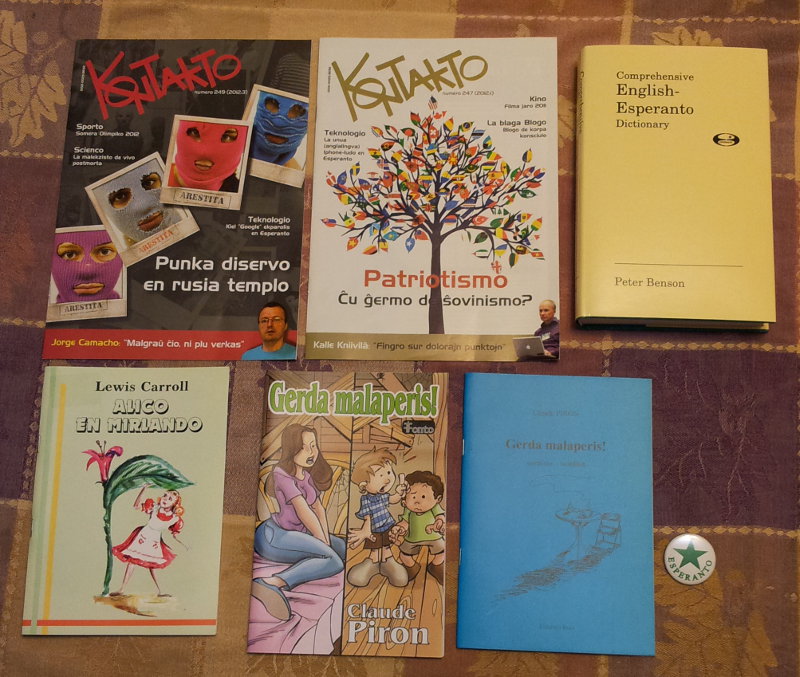
Here is what I took home with me:
- Alico en Mirlando (Alice in Wonderland)
- Gerda Malaperis!
- Wordlist for Gerda Malaperis!
- English-Esperanto Dictionary
- Two copies of Kontakto magazine
- Some Esperanto buttons and pins
My idea to try reading Lord of the Rings in Esperanto was thwarted when I took a look inside the book and saw that the Esperanto is more difficult than what I was reading in the Alice in Wonderland ebook on my phone. I decided to read Gerda Malaperis! and the entire Alice in Wonderland first.
“The Secret of a Wonderful Memory”
I was very surprised to open one of the Kontako magazines to see an article called La sekreto de mirinda memoro (The secret of a wonderful memory) by Alberto Ferrari. The article is in issue 247, page 16. The article covers the major system, and assigns the following sounds to digits:
- 0 = s, z, c, ĵ, ŝ
- 1 = t, d
- 2 = n
- 3 = m
- 4 = r
- 5 = l
- 6 = ĉ, ĝ
- 7 = k, g
- 8 = f, v
- 9 = p, b
These look like good, logical choices for Esperanto. In English, the consonants ĵ and ŝ would be assigned to the digit, 6, but maybe it works better in Esperanto to have them assigned to zero.
The article covers basic principles like exaggeration – for example, imagining a gnat (mosquito?) the size of a whale, with a pikilo (stinger?) as if it were going to drill for oil.
Here are the author’s example images for 1 to 10:
- 1 = teo — tea
- 2 = enuo — boredom
- 3 = hejmo — home
- 4 = oro — gold
- 5 = ajlo — garlic
- 6 = ĉu? — imagining a question mark
- 7 = hoko — hook
- 8 = ovo — egg
- 9 = boao — boa
- 10 = duŝo — shower
So, maybe it wasn’t just wishful thinking when I created a section of the memory forum to discuss memory techniques in Esperanto.
Se iu konas la aŭtoron de la artikolo, bonvolu inviti lin al nia forumo! :)
Esperanto Comprehension
I mentioned that I’ve been going through Esperanto flashcards on Anki. The meetup involved a couple of hours of presentations in Esperanto. I had to introduce myself to the group in Esperanto, which was difficult, but I hope that people could understand me. My Esperanto speech is very slow and halting because I have to search for mnemonic images in my head for some of the words.
I could recognize most of the words that people were saying, but I had trouble processing them into sentences at conversation speeds. I got the basic idea of most of the presentations though. One of the speakers spoke in very clear Esperanto, and I understood most of what he said.
Overall, I was happy with my progress in Esperanto for the amount of time that I’ve spent on it. I just need more practice.
Alice in Wonderland
When I got home, I looked at the book and noticed that Alice’s name was Alico instead of Alicio as in the ebook I was reading. It turns out that there is more than one translation of Alice in Wonderland in Esperanto.
Here is a quick comparison of the versions. First the original:
Alice was beginning to get very tired of sitting by her sister on the bank, and of having nothing to do: once or twice she had peeped into the book her sister was reading, but it had no pictures or conversations in it, ‘and what is the use of a book,’ thought Alice ‘without pictures or conversation?’
Here is the ebook translation by E. L. Kearney:
Alicio, jam longan tempon sidinte apud sia fratino sur la deklivo, tre enuiĝis pro senokupo. Unu, du foje ŝi prove rigardis en la libron kiun la fratino legas, sed povis vidi en ĝi nek desegnojn nek konversaciojn, kaj “por kio utilas libro,” pensis ŝi, “enhavanta nek desegnojn nek konversaciojn?”
Here is the translation in the print book I just bought that is by Donald Broadribb:
Alicon komencis multe tedi la sidado apud sia fratino sur la bordo de la rivereto, kaj la manko de io farinda; unu-du-foje ŝi regardetis transŝultre la libron kiun legas ŝia fratino, sed ĝi havas nek bildojn nek konversaciojn, “kaj kiel utilas libro, — pensis Alico, — sen bildoj aŭ konversacioj?”
The Esperanto in the latter translation is more difficult, but I like some of the word choices better. I think that “la bordo de la rivereto” (the bank of the stream) seems more accurate than “la deklivo” (the hillside?), and “bildoj” (pictures) seems more accurate than “desegnoj” (designs).
Here are quick, rough translations back to English:
Ebook: “Alice, already long time sitting next to her sister on the hillside, very got-tired because of nothing to do.”
Print book: “Began muchly to tire [Alice] the sitting next to her sister on the bank of the stream, and the absence of something worth doing.”
I prefer this printed version that I just bought. If any fluent Esperanto speakers have an opinion of the translations, please let me know.
The Dictionary
I made a big mistake with the choice of this dictionary, since it is only English to Esperanto, when I only need Esperanto to English at the moment. I didn’t look at it well enough when I purchased it. I will have to get another dictionary before I start Alico en Mirlando.
Gerda Malaperis!
In the meantime, I will read Gerda Malaperis! (“Gerda Disappeared”), since I also got a wordlist for the entire book. It’s a mystery story that is designed to teach Esperanto to beginners. I also have all the words from the book in an Anki flashcard deck.
If anyone else is reading Gerda Malaperis!, click here to check out the resources on Enrique’s site. Enrique offered me some suggestions by email as well as at the meetup yesterday, and he has been very helpful. His website is esperantofre.com.
Also, if you are looking for Esperanto Anki flashcards, check out this page. There are more Esperanto decks there than I previously knew about, so it looks like I will have something to keep myself occupied in my spare time.
Why Esperanto?
If you haven’t been following my previous posts about Esperanto, here are some of the reasons why I’m focusing on Esperanto at the moment:
- The Propaedeutic Value of Esperanto — many studies over the past 100 years show that learning Esperanto speeds up the learning of additional languages. For example, if someone spends one year studying Esperanto and three years studying French, they will have a higher level of French after four years than someone who studied only French for the four years. If one wants to learn languages, it seems like a great idea to start with Esperanto.
- Esperanto has perfectly regular grammar, making it ideal for experimentation with memory techniques and languages.
- Esperanto is very useful for travel. I’m not a fluent Esperanto speaker yet, but have already met Esperanto speakers in a few countries and have had great experiences with the language. There are many Esperanto speakers worldwide, and they are generally very friendly and welcoming. You can find them in places like Lernu.net (over 100,000 members),
Google+, and in many other places around the Web.
If you would like to start learning Esperanto, check out the “16 rules of Esperanto grammar” to get a sense of the basics, and then browse through the resources on sites like Lernu! and esperantofre.com.


