Creating a Memory Palace for German Vocabulary and Grammar
After 12 hours of German classes* and a few 10-mile walks around Vienna, I think I have come up with a mnemonic system for remembering both the gender and pluralization of German nouns.
I spent a week in my German class before attempting to create a memory town. I wanted to understand the structure of the language a little before starting to memorize things.
For example, one of the difficulties of learning German is that nouns have three genders and about 12 ways to pluralize the nouns. All of that has to be memorized for each word.
I didn’t know if it was more important to separate the nouns into three sections of a memory town based on genders (as in the method described by Dominic O’Brien), or if it would be better to organize nouns by the way they are pluralized, or even both, which would require about 36 (3*12) areas in the memory town just for nouns.
If I had a lot of free time, that method might be nice, but to be realistic, I would probably never finish that task.
A Simpler Memory Town
After thinking about it for a long time, I realized that I could separate the nouns into three sections of the town by gender, and then use image modifiers for the 12 types of pluralization.
I think that the advantage of this way over doing it the opposite way, with 12 sections of a memory town (pluralization) and three image modifiers (genders), is that it should give me fewer repeating images due to the smaller number of image modifiers.
The Memory Town Layout
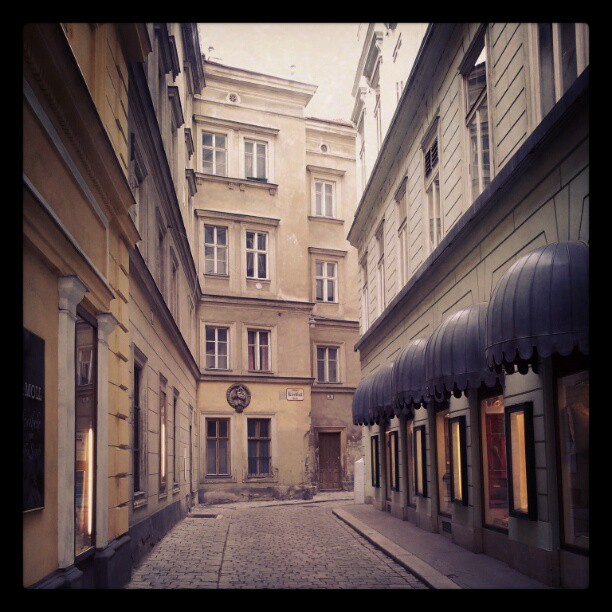
The sections of my memory town for German nouns are the following districts of Vienna:
- 1st district: feminine nouns.
- 7th district: neutral nouns
- 15th district: masculine nouns
Examples of Plural Image Modifiers
At the moment, some of my image modifiers for plurals are:
-s, -e, -n
I have a mnemonic image for every letter of the English alphabet. “S” is a saw blade. “E” is a canyon wren. “N” is an image of cranberries.

Example:
The mnemonic image for the word Schule is in the old city (1st district) so I know that it’s a feminine noun–die Schule–and the cranberries tell me that the plural is die Schulen.
-en
Sometimes I drop the first letter from a word to create a mnemonic image, so in this case, I added one: “en” becomes “hen”.
-er
Er means “he” in German. The first thing that came to mind is the He-Man cartoon and his distinctive sword.
Example: In the 7th district, a child (Kind) is sword fighting with a picture (Bild) on the side of a building. The 7th District tells me that they are neutral nouns, and the sword tells me that the words are pluralized with -er.
I already know many of the nouns from their similarity with English or Esperanto, so I don’t need to attach these particular images to their German sounds.
ä/ö/ü-er (Stem Change)
My image for this plurization is Zephyrus, the west wind. For some reason, that was the first thing that came to mind, probably because the beginning of the Canterbury Tales is often stuck in my head, triggered by overhearing German words like Sonne, auch, and Holz:
Whan Zephyrus eek [auch] with his sweete breethe Inspired hath in every holt [Holz] and heethe The tendre croppes, and the yonge sonne Hath in the Ram his halve cours yronn Also, “y” in German and Old English is pronouned ü, so “Zephyrus” isn’t a giant mnemonic leap from “ü-er”.
ä/ö/ü-e (Stem Change)
This sounded like ʻoe to me which means “you” in Hawaiian. So this image is a palm tree.

No Change
The image for nouns that don’t change when they become plural is a black hole.
In the 7th district, a girl is leaning out of a window and being swept into a black hole. They are in the neutral part of town, so it it’s das Mädchen and das Fenster, and the black hole tells me that the spellings remain the same when being pluralized: die Mädchen and die Fenster.
Fenster sounds like fenestro in Esperanto, and Mädchen is maiden in English, so the words themselves are often easy to remember. It’s just the grammar that is complex.
(To see the method I used to memorize the 12 definite articles of German during a break in class, see my previous post.)
Does my explanation make sense? If not, please leave a comment below and I’ll explain further. As usual, this is an experiment that is in progress. I may learn something else about German grammar that requires me to do things a different way. I hope to have more to report soon.
P.S., my vocabulary lists are here (in progress).
*This post was written a few days ago, but edited and published today.
Photo of cranberries © Muffet under the CC BY 2.0 License.
Memory Palace Guide
Learn more about how to use memory palaces.
- How to Build a Memory Palace 🔥
- Learn How to Use Sherlock's Mind Palace 🔥
- How to Create Virtual Memory Palaces 🔥
- Books About Memory Palaces
- How to Reuse Memory Palaces
- List of Memory Techniques for Studying
- How to Use Spaced Repetition
- How to Use the Method of Loci
- Advanced Memory Palace Tips
- Memorize Numbers with a Memory Palace
- Memory Palace for Language Learning
- Simonides of Ceos and the Method of Loci
- Palace Run: A Memory Palace Game